Kulpreet Singh’s short statement on climate change and agricultural crisis, Indelible Black Marks, leaves much unsaid—an ongoing problem with climate justice art. Nonetheless, the Hayward Gallery show could not have come at a better time.
For his first solo show in the UK, Kulpreet Singh plays with ideas of trace, action and immediacy to bring the reality of the climate crisis to viewers. Through painting, sculpture and film, Singh creates an immersive experience that foregrounds the reality of being human, assessing the power we have, as well as lack, to create a cautionary tale about the impending reality of climate change.
Before the show’s central film, Singh presents a large, five-panel painting created with stubble-ash and fire that resembles a grey landscape shrouded by smoke. It’s only once you get closer that you see the imprint of burnt stubble, a remnant of the ash’s source. For a second, they resemble eye floaters, the small bits of debris that invade your vision but that you can never look at directly. While unlikely to be a deliberate likeness, this comparison does cut to the heart of why these black marks are “indelible.”
Burning is temporary; it creates byproducts, like ash, but generally it irreversibly removes something. Singh has side-stepped this irreversibility by imprinting the burnt stubble onto paper—all of a sudden, the action of burning and its consequences become visible, immortal. The floaters come into registerable vision and won’t leave. In 2026, as wildfires roar through Europe, the consequences of an ostensibly distant climate collapse are becoming dangerously real. The time is up for us to look away, no longer shrouded by the smoke of futurity.
Opposite the painting is a small hay bale for viewers to sit on. The bale confronts the painting with its fuel and referent, before confronting the after. But the before and after of what? Whether you choose to sit or stand in front of the work, you complete the cycle: filling the gap between the hay and the ash is the human action, the Promethean perpetrator.
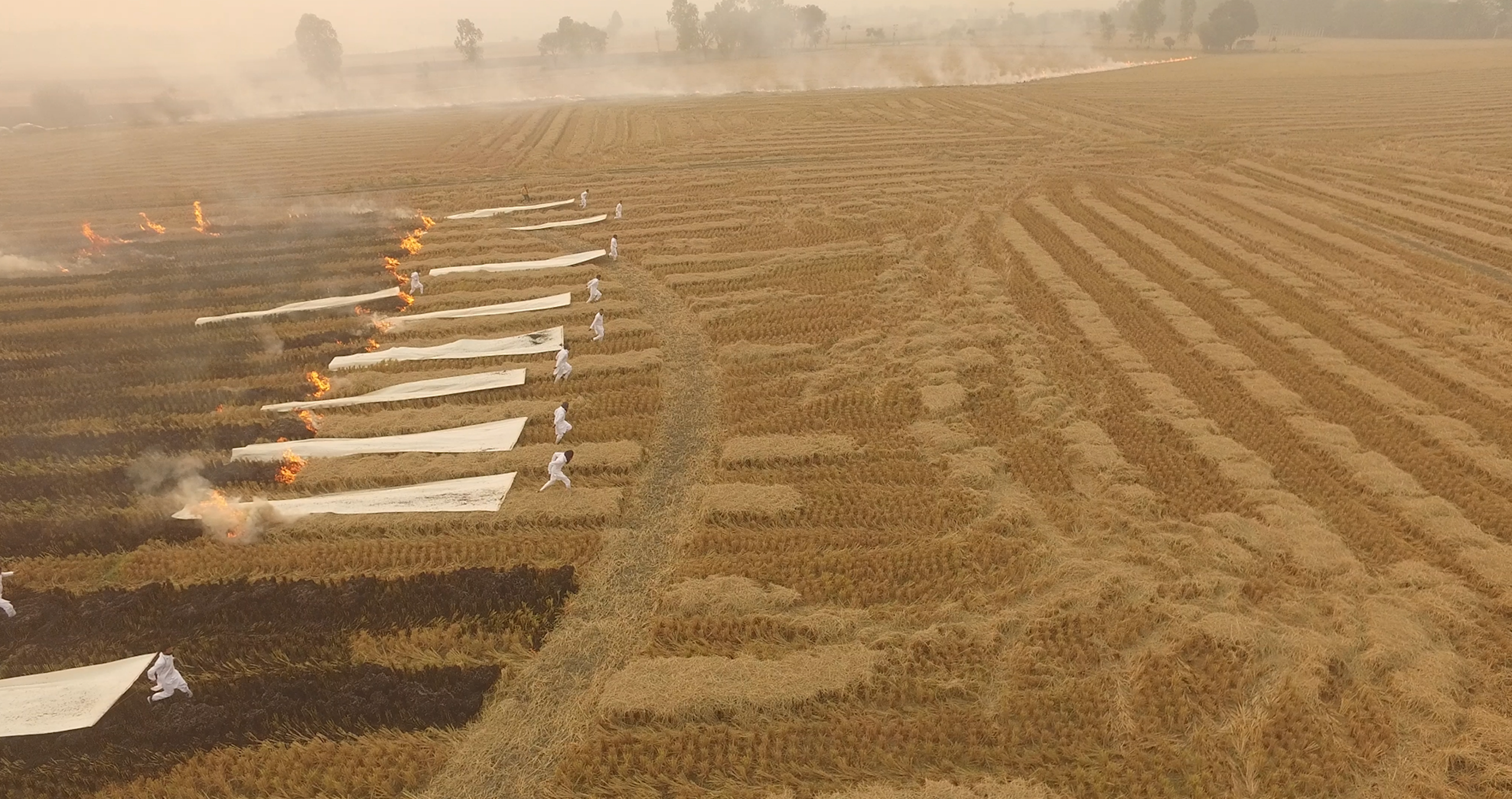
We can hear this connection in the sound that leaks from the screening room next door. In this room, hay lines the walls, surrounding viewers with flammables. The action of burning becomes less didactic and more threatening, particularly when accompanied by what is onscreen: the central film in this show, Indelible Black Marks. The video follows performers dragging long white canvases over burning fields, initially swirling patterns and then settling in rows that completely cover the smouldering stubble. Beauty is attributed to the land as a form of distraction, but only until the edges of the canvas begin to curl and blacken, revealing the dead land beneath.
This method of burning fields is common in farming to prepare the land for new crops. But this cycle of regeneration hides the fact that, every time the crops are burnt, they send harmful gases into the atmosphere, damaging the earth in ways that take much longer to repair. While the film teeters between nihilism and hope, its message is consistent: humans started this cycle, so we must finish it.
While unfortunately paired with Anish Kapoor’s huge retrospective at Hayward Gallery, there’s definitely something to be said of the contrast between the great spectacle of Kapoor’s ambitious installation and the more grounded didacticism of Singh’s show. This is the only approach that will aid in the fight against climate change. It’s an approach that admits responsibility, recognises damaging actions to kickstart reparative ones—the regeneration of a new crop from the ashes of the old.
Kulpreet Singh: Indelible Black Marks was on display in Hayward Gallery’s HENI Project Space. To find out more, go to their website.
Featured Image: Kulpreet Singh, Film Still from Indelible Black Marks, 2022-24, Courtesy the Artist and Galerie Mirchandani + Steinruecke.


