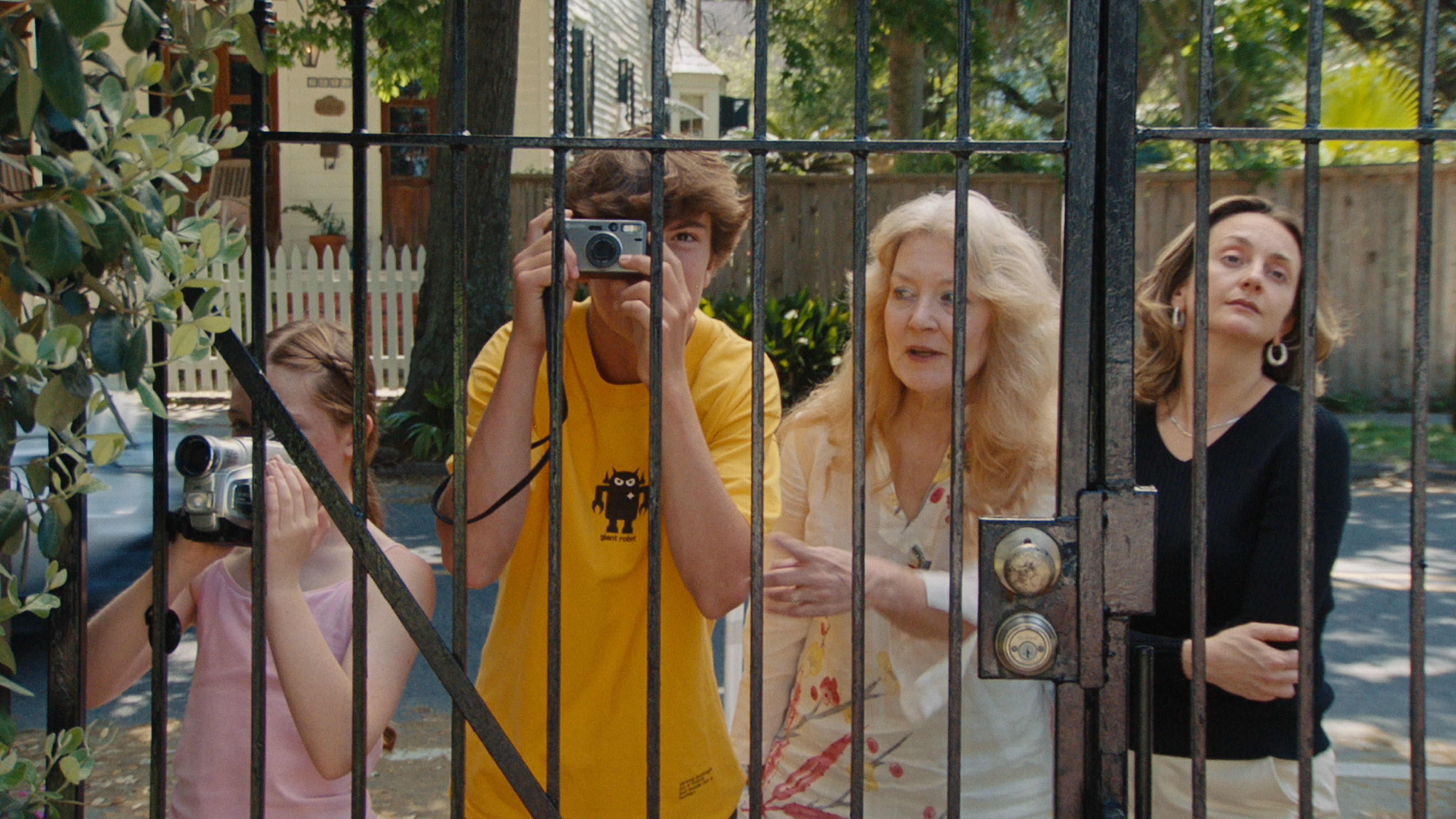
Martine Syms, the conceptual artist and filmmaker behind The African Desperate (2022), brings several new wall paintings, sculptural works and two video works to Sadie Coles’ Kingly St venue. The show centres on the release of a new short film, RW-LO (2026), which will premiere at both the New York and BFI London Film Festivals this autumn, shown here in the gallery’s Regent Street Viewing Room. In this docu-fantasy about a real-life interaction between a reality-show contestant and a superfan, the nervous cynicism of internetification melts away to reveal how human connection has adapted to techno-cultural changes over the last 25 years.
In the gallery entrance, Syms has installed the latest iteration of her concept store, Dominica Publishing. Shopping bags spill over the path to the stairs, blithely raising our suspicions: “Is this really a shop for the exhibition? If so, why is their stock on the floor? If it isn’t a shop, I’m going to be in serious trouble for trying to tidy this mess up”, etc. But our confusion, our concern for proper etiquette, seems to be what Syms is trying to provoke: ‘I was a shop girl,’ Syms notes, ‘some people were servers. These jobs teach you everything there is to know about humanity.’ The thin veil between humanity and the transactional relationship of the shop sways gently.
Climbing to the main gallery, this self-awareness is put in a new context in the living room Ex Voto, the first of two new video works, is set. In the front corner, the living room is modelled out of 3D-printed foam board and clay. The living space has been compacted into code, a set of instructions for its own remodelling in miniature, to be observed from an impossible distance. As you circle the miniature, a large mural of the same scene reveals itself on the far wall. Presented as an optical illusion, we lose control of the setting; the living space no longer appears futile, nor reproducible with digital code. This rendition is more reliant on us, the human viewer, and our perspective within the space.
With these ideas of perspective and reality, we are drawn towards the mural, where the film is being shown. The 4:3 film – split into three 9:16, smartphone-shaped screens – opens with a director and her two leads returning to an apartment after a wrap party. The façade of acting, both in their professional and social settings, falls away as they enter the home. But as we’ve seen, this separation is a matter of perspective. As they chat and drink some more, the director starts talking about multi-dimensionality. She eventually shows the actors a video explaining the elaborate theory, one that is interestingly more based on sociological ideas of professional and social status than physics or astronomy. What ensues is a trip in which the director falls through planes of reality, fueled by paranoia about her social status, work and purpose. Cut between visions of this trip are the actors’ perspective, who keep chatting while she dances erratically behind them.
The fear that nefarious digital agents warp our reality (for the director, the reality of social relations, but also real-world fears of AI’s capabilities) becomes almost foolish. Ex Voto ends the next morning, as one of the actors humbles the director with a witness account of her trip. The futile, nihilistic model of subservience to technology now appears cute in the face of this absurdity.

For Syms, human reactions to technological and cultural advancements keep us ahead of the curve. She can make this case today because it has happened before; in the Viewing Room, RW-LO takes us back to the start of the millennium, during the filming of The Real World: New Orleans (2000). Mixing footage from the show, home video and newly filmed material, the short film tells the true story of Brent David Freaney, a Deep South teen who became obsessed with The Real World castmate Melissa Howard. The film is at times disorienting, jumping seamlessly – to its credit – between found and re-enacted footage. The register of the television show shifts. What was originally a spotlight grab comparable to Big Brother or Love Island – ironically not the “real world” – is broken down to reveal the humanity beneath. It is telling that the event in the show that Syms chooses to re-enact is when the castmates experience a white boat guide use a racist slur, causing outrage for Howard but forcing some of the others to retreat to the safety of saying “I just don’t engage with ignorance.” The spotlight becomes a haven for ignorance, which is why Howard eventually escapes it to connect with Freaney.
Said aloud, “knot eye” might sound like “not eye” or “not I”, perhaps a reference to the deception in Dominica Publishing, The Real World or the short monologue by Samuel Beckett. On the contrary, “knot eye” connotes binding, communicating the unbreakable tie between these images and the humans that create, perceive and scrutinise them. For the castmates, as well as the players in Ex Voto, personality and actions are commodities. Indeed, the birch boxes in the Viewing Room that look like seats – again, works of art that invite casual vandalism – have “martine” engraved on the side, reducing Sym’s artistic identity to a brand reminiscent of the Dominica Publishing stand downstairs. But this doesn’t take away our suspicion; in fact, it makes it more attuned.
The three stages of nihilistic scepticism – fear, comedy, and connection – that have existed since The Real World: New Orleans, in the wake of the millennium bug, remain today, forming the rhythm of Knot Eye. Of course, there is a lot to be wary of; all too often the millennium bug is used by maniac AI bosses to justify their world-altering technology. But what they fail to point out, and what Syms’ show focuses on so astutely, is how we adapt to these advancements. That human connection as a resistance to digital takeover is the real history repeating itself.
Martine Syms: Knot Eye is on display at Sadie Coles HQ, Kingly Street, until 7th November. To find out more, visit their website.
Images: Martine Syms, RW-LO, 2026 [Still], video, colour and sound, duration: 21 min 42 sec © Martine Syms. Courtesy the Artist, Sadie Coles HQ, Hoffman Donahue and Sprüth Magers. RW-LO is commissioned by The Vega Foundation with additional production support from The Museum of Contemporary Art (MOCA), Los Angeles.


