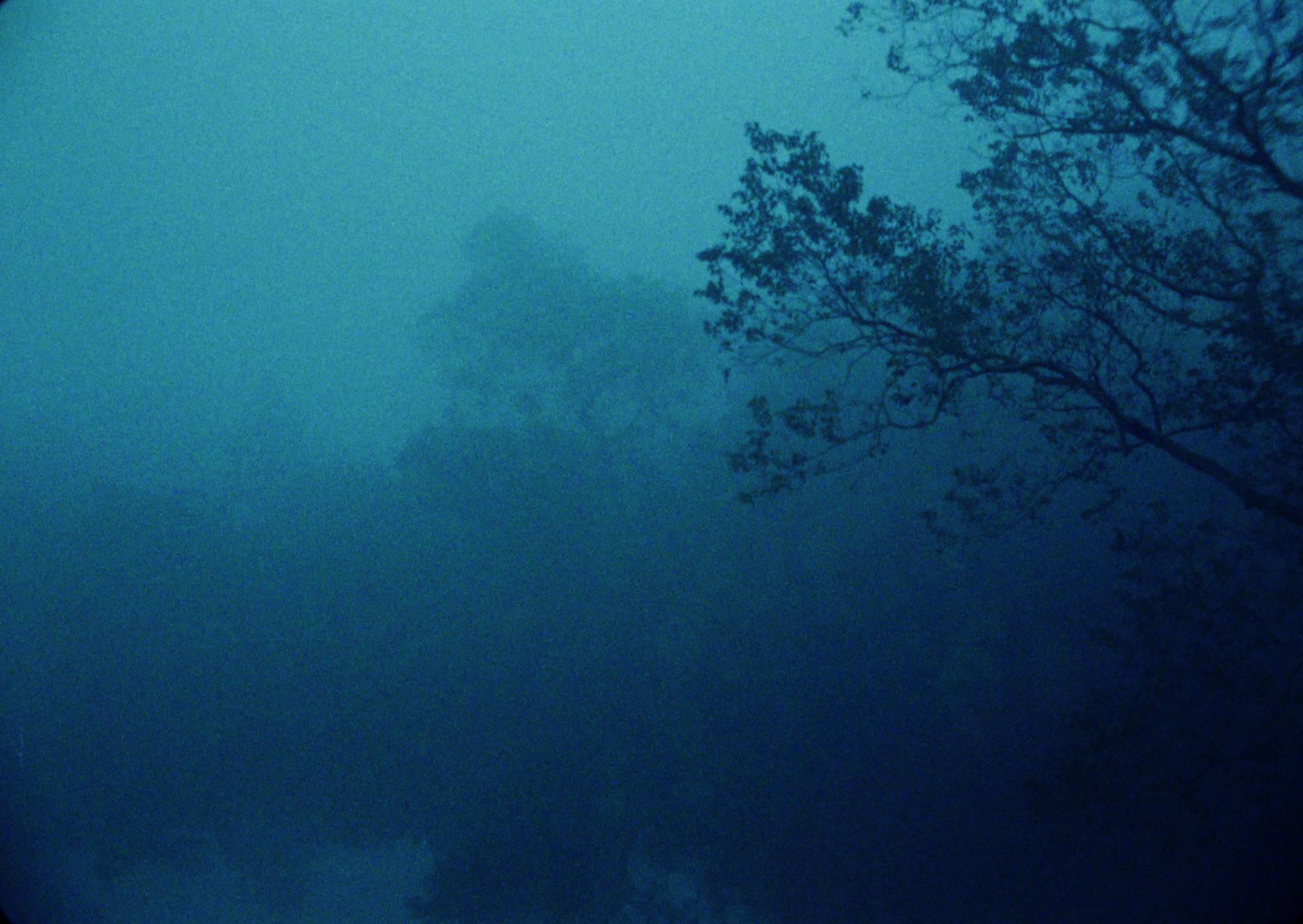
With Good Night, Asako Ujita presents a beautiful, intimate exploration of culture, place and memory at the margins of light, image and sound.
Stretching the bounds of meaning and understanding, Good Night operates entirely in the realm of memory; arguably a landscape work above all else, Ujita’s practice of understanding the past relies on listening through silence, seeing through the darkness of dusk.
Silence is where we begin. Two researchers travel to the Southern Taiwanese forests, walking around caves and lakes with a sound recorder and a large dish. They are searching for sounds of the past, specifically violent, colonial pasts that once reverberated off the land but have since fallen silent. Their quest mirrors Ujita’s, whose great-grandfather lived in Taiwan during the Japanese occupation. Working from a single postcard, Ujita attempts to build not an image of the past, but the ground on which we can connect with it. We see an old temple, speak to locals, and explore the quiet forest, dense with both trees and histories, just like the researchers.
The minimal dialogue in the film, while contributing to the silence, also tells a story of our responsibility as humans in these situations. Ujita’s connection to the land is ancestral, deep and, in many ways, inaccessible. The land, however, is the same as it was all those years ago. Good Night is an attempt to listen to the land; to give it a rare chance to tell its story. The story doesn’t give us much context for what we are looking for. There is a sense, however, that doing so would undermine the journey and indeed would be speaking for the land.
It’s also because the journey had no known destination; that’s where conversation does come in. While talking to her ancestors is impossible, Ujita gives us access to them through the stories told by friends and locals. She maps a vast landscape, discovering its history through the gaps; a process of listening, both to the land itself and to others and their experiences.
Listening as a practice is not didactic in Good Night, but its benefits are clear. For Ujita, this comes from a place of love; the film sits at the boundary between knowledge and loss; between, as the name suggests, the daylight and the darkness of night. It also came before birth, as Ujita was pregnant with her first son. The sense of responsibility pairs with a responsibility to preserve. How will Ujita pass down what she discovers in the landscape? And how will it be received? The period of transition between day and night, between knowledge and loss, is understood more deeply and personally by Ujita, who herself sits at the boundary between knowing the past and informing the future.
At no point in Good Night does the depth of this responsibility take away from the landscape itself, because it is through this landscape that we understand it. In the silence of the forest, or the light rush of lake water, we are given room to listen to and learn from the land. Our connection to the earth is only becoming more important as the years go on, for a myriad of reasons—the reasons that justify Ujita’s approach to memory in Good Night are as pivotal as any other.
To find out more about LUX exhibitions, visit their website.
Featured Image: ‘Good Night’, Asako Ujita, 2026. Courtesy of the artist.


