Sung Tieu’s work, spread across the small gallery’s fragmented rooms, resists being taken in all at once. Each element of the ‘day’, represented across the various works, appears as a fragment rather than a whole. For what is a day but a series of moments we try to string together with a sense of self-imposed cohesion? As Sung Tieu herself succinctly puts it, ‘I guess we define our day through the punch of the clock.’
Beyond the fluorescent lights of the entryway, four large tile mosaics line the walls. Upon first inspection, it is disorienting. It is difficult to make anything out from the arrangements of semi-repetitive beige squares. Only when I stepped back and read the titles did it all click: Untitled (Shower Room / Left), Untitled (Shower Room / Window), Untitled (Shower Room / Right), Untitled (Shower Room / Door). As though looking through the blur of steamed-up glass after a nice warm shower, the individual mosaics cut the room into the same pieces my eyes did: one look, a gap, the next look. The spectator is forced to take in each angle of this shower room deliberately and slowly. The day is no longer defined by the punch of the clock; instead, every glance and movement holds equal significance, regardless of chronology, as the viewer looks around the shower room’s fractals. For many people, the shower marks the start (washing off sleep, getting ready for the day) or the end (washing off the day, preparing to sleep) of a 12-hour period. As people walk in and out of the gallery, Tieu asks the viewer to reassess how one marks time in their day.

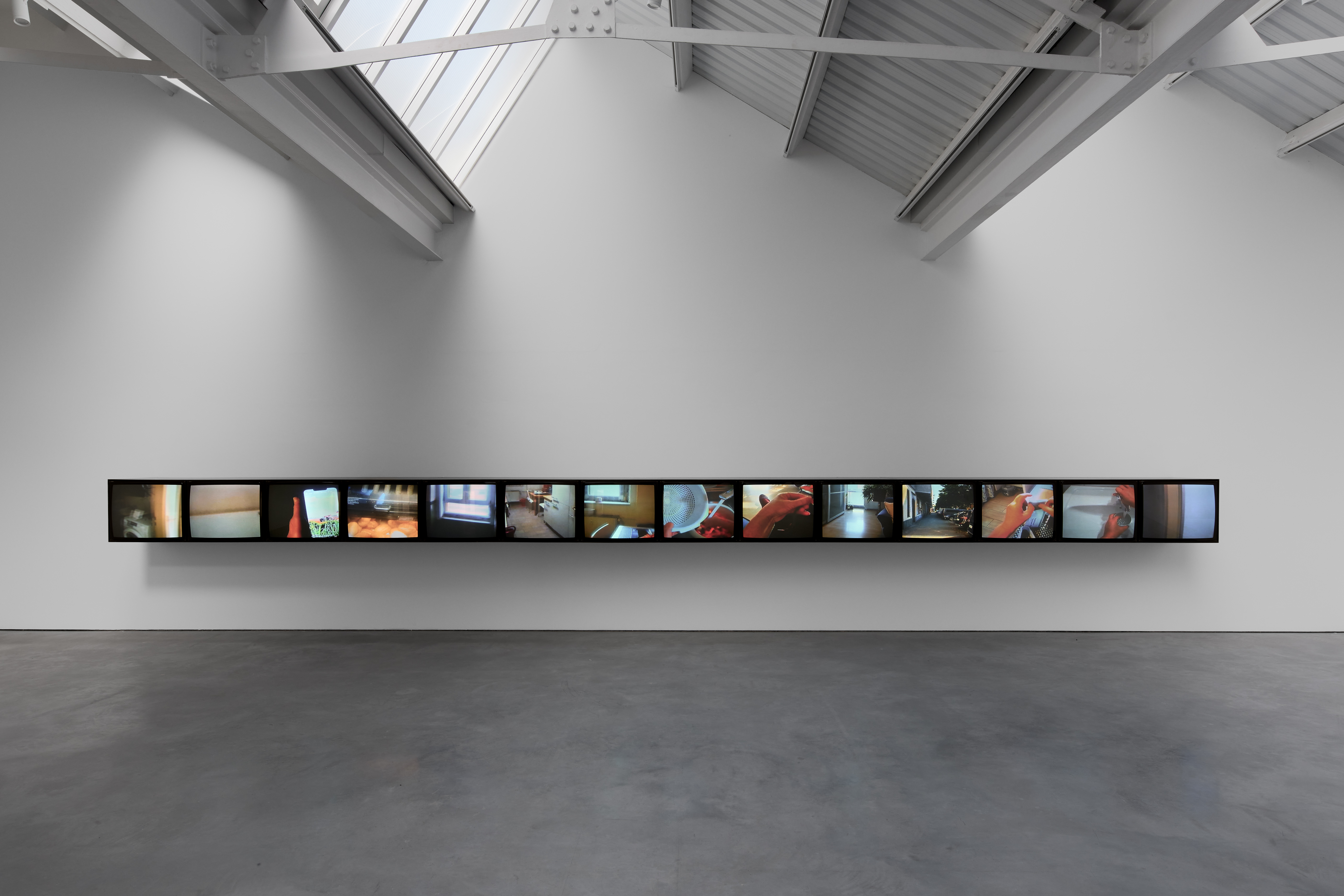
The next room is void of light, broken only by fourteen CRT monitors playing a continuous loop of daily tasks from first-person perspective. Stretched horizontally along the wall, the screens strain the eye to take it all in at once. Perhaps an intentionally impossible task. My friends remarked that it felt “exactly like how the inside of [their] brain worked”, with the screens mirroring what it was like to wind down at the end of the day and reflect: ‘how was their day?’. As each screen moved from task to task in Tieu’s day, the idea of time, how and when we do things, how much we enjoy them as we do them, and how indifferent we are, became increasingly poignant. Our days are forced into segments of getting from A to B. When we are prompted to look at how we spend our days, Tieu carefully examines which elements we construct to build an accurate representation of our past 24 hours.
‘Just to get a sense of time, we somehow make that mental separation in our minds to divide the day.’
Reminiscent of sequences from Jeanne Dielman (Chantal Akerman, 1975) and 71 Fragments (Michael Haneke, 1994), Tieu is seen peeling carrots, scrolling on her phone, mopping the floors, and bathing her feet. These moments are not presented as significant events, but as small, routine fragments that make up a day and are often forgotten when we later attempt to recall it. By isolating these otherwise forgettable actions across the screens, the film raises the question of what ‘moments’ one deems worth remembering. Echoing the structure of social media, in an age of feeds and stories, we perceive and categorise people’s lives through the carefully crafted pieces they allow us to see. As days are broken into postable parts, the work asks who is choosing and what gets left out. The screens do not present a coherent narrative; instead, the artist pieces together these divisions of her day like we would our own.
Sun Tieu: How was your day? is on show at Emalin, Helmet Row until 14th November 2026. To find out more, visit their website or follow them on Instagram.
All images courtesy of the artist and Emalin, London © Sung Tieu. Photography by Stephen James.


