With ‘Narrative Warfare’, Jordan Lord reclaims the ‘tell, don’t show’ rhetorical approach as a tool for resistance against fair-right domination of the image economy.
In the tradition of documentary, we cannot categorise Jordan Lord’s latest film, Concealed and Denied. This isn’t only because it deals with the rapidly evolving culture of social media politics, or because their approach is so meticulous that it engages with a certain journalistic distanciation (for what reason it should become clear). It’s more because it doesn’t really “reveal” anything—at least in a traditional sense.
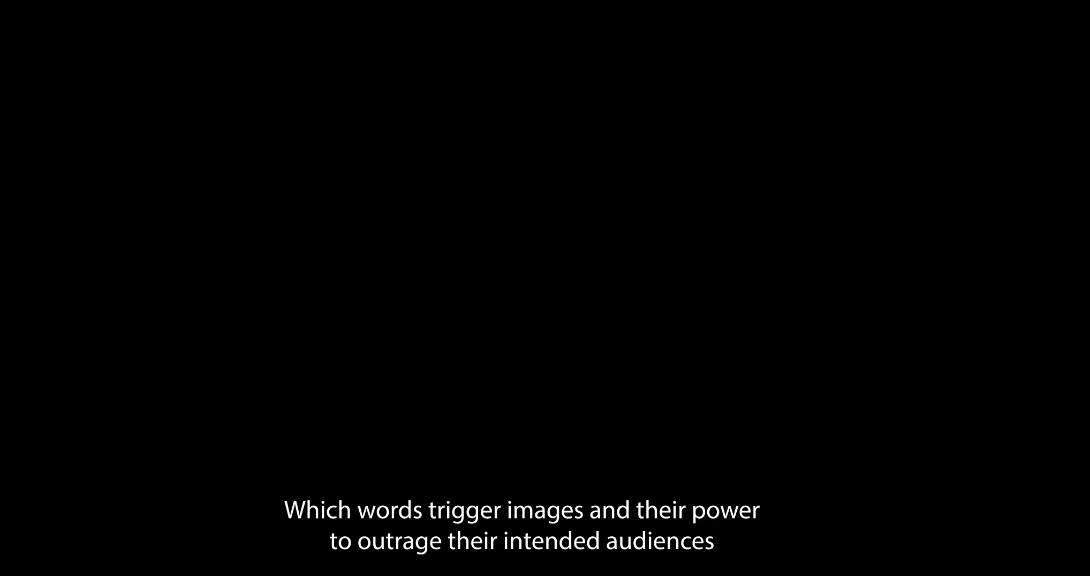
The film, which premieres at the exhibition, follows the professional development of a far-right political activist and lobbyist. It tracks his internet presence as a pseudo-journalist, to fringe broadcast appearances and national network television, to a member of an influential group that circles Donald Trump. This is all told through archival clippings and broadcasts—all somewhat grounded by an appearance on The Joe Rogan Experience (the mark of condemnation, if one did exist). However, there is a deep irony that sits at the base of Lord’s thesis about images and censorship: Lord describes all of this archival material to us, but they don’t show us.
What LUX call an “archival documentary without the archive” consists of different coloured screens, coded to the different types of source used (an X post, an article, etc.). Subtitles, usually a supplementary feature of film and television, become a vital part of meaning production, not least because of the way Lord also uses them to denote their own edits to the documents. What results is a drawn back approach to the rise of a major player in the right-wing project in the United States, who hid behind graphics and slogans—the currency that the project has long traded in—to gain influence.
Lord’s concern here is clearly with the modern image economy, both as a political tool and as a commercial one. Make America Sleep Again, the dual-channel work displayed on two CRT monitors adjacent to the main screen, shows a compilation of FOX ads catered towards miracle, “natural” cures to disabilities and ailments. Not only does the political shine through in hindsight, now that the MAHA movement has gained pace, but it also informs the communication structure of the ads. Lord and LUX are quick to point out the similarities in the rhetorical approach of politicians and health advisors on television. Indeed, the dividing line drawn between what we see on each monitor is not different images, but images and captions, isolating the rhetoric by putting it into a direct literary mode as in Concealed and Denied.
From Raymond Williams to Tania Modleski, commercials have long been seen as fluid, seeping into the programming and even the domestic lives of viewers; Modleski specifically notes that daytime versus nighttime programming can even be understood along gendered lines. This is no less apparent in the politics of health espoused by these commercials, which, once you know what they are, seem to interfere and interrupt the D/deaf-friendly form of Concealed and Denied, travelling through the room on the light and high-pitched buzz of the cathode tubes.
As a work of almost image detoxification, ‘Narrative Warfare’ sits within a trend of moving-image artists concerned with the very modern subject of subtitles, pulling them from their supplementary position into the foreground. No artist, however, is using them to bite down on such pertinent political issues.
Jordan Lord: ‘Narrative Warfare’ is on show at LUX until31st May 2026. To find out more, visit their website.
Image: Still from ‘Concealed and Denied’, Jordan Lord, 2026.


