Goldmiths CCA pieces together a the radical history of Paper Tiger Television in a recent retrospective on the collective.
I am someone who enjoys nothing more than returning home after a long day at work, sinking into my sofa, and letting the soft, hazy glow of whatever trash TV show I’m currently consumed by occupy the little brain activity I will carry out for the remainder of the evening. The idea of spending those precious few hours further developing my critical consciousness towards an investigation of the corporate structures of the communications industry feels somewhat dubious.
But this was exactly the goal of Paper Tiger Television: to occupy the glowing vortex of our screens for half an hour every week and turn it back on itself; to illuminate how media, shaped by capitalism, inform the public consciousness. This mission is aptly summed up by the subtitle of Goldsmiths CCA’s exhibition on the collective, Paper Tiger Television: It’s 8:30. Do you know where your brains are?
Paper Tiger Television was a New York-based non-profit public access television show that ran for over 40 years from 1981 until the late 2000s. The volunteer-led media collective produced 400 videos which aimed to deconstruct, demystify, and critique corporate media and the information industry. Each episode consists of one guest, usually an academic, artist, or activist, who orates their critique of the chosen text. Not only through close readings of a diverse array of texts such as The New York Times, cigarette ads, or Regan’s response to the AIDs crisis, but also through aiming at the corporate structures, shareholders, and private individuals who produce and own the media we consume daily. The result is an impressive archive of media theory in zany low-budget form, which Goldsmiths CCA presents to the UK for the first time.
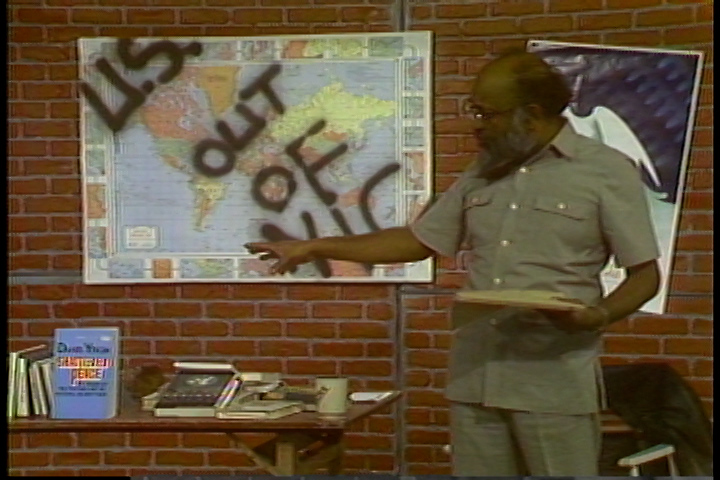
To enter the exhibition, one must step through a cardboard cutout of a broken TV, signalling with a heavy hand the deconstruction of mass media carried out by PPTV’s productions. There’s not much subtlety about the exhibition or PPTV as an experience; episodes dripping with irony in both the political commentary and DIY cardboard sets, which serve to both send up the expensive gloss of popular late-night talk shows whilst also proudly making the case for ultra-low-budget grassroots community media. The cardboard sets were not a purely aesthetic choice, but rather an economic necessity in making the show possible, as to shoot in New York studios, they would need to fork out $55 an hour. Thus, economic constraints shape the form of the show. Episodes always end with a declaration of the dirt-cheap production costs, offering total transparency to viewers.
The exhibition features 40 videos, chosen by PPTV members, and presents them in chronological order. This allows visitors to see how the production and editing evolved over time. Early episodes consist of a pretty simple setup; one person, talking—just a straight live broadcast. By the time we get to the 2000s, the productions are still delivered live, but littered with cutaways to montages, edited footage, and more visual complexity.

As such, a wealth of videos are presented, each one clocking in at around 25 to 30 minutes; it is impossible to view them all without spending a whole day at the CCA. Highlights include Archie Singham Reads Foreign Policy: A Look at the Old Boys’ Network, introduced in the screening/talk by academic and friend to the late political scientist Vijay Prashad, who described Singham as a “good colonised Asian man” whose rhetorical style is “delightfully colonial,” and something we should all try to emulate over a stiff whisky. Singham cleverly deconstructs the obscure and dense language of foreign affairs academic journals, which he terms the intellectual industry developed to justify the industry of war. Through humour and ironic posturing, Singham charges the journals with using jargon which appears impenetrable to the non-academic class, discouraging participation and understanding of global affairs.
Martha Rosler Reads Vogue: Wishing, Dreaming, Winning, Spending is also one of the most compelling performances, its critique and analysis deriving from the emulation of Vogue’s strategies. Rosler flips through the pages of a Vogue magazine, her hands gently caressing the glossy pages which feature close-up images of perfect skin, legs, and hair. Skin and paper surfaces become indistinguishable; like the seductive images that draw one in, Rosler’s emphasis on tactility and linguistic play with the endless sliding signifiers similarly seduce the spectator into a cascading eroticism and excitement. By the end of the performance, “love, desire, romance, excitement, luxury” have become “narcissism, threat, voyeurism, submission,” and the accompanying images appear sinister, inhuman and controlling of women’s bodies.
As each episode relies heavily on the persona of the speaker, episodes vary in their compellingness. Yet, all of them offer a unique insight, as PTTV brings together a diverse array of speakers to explore a variety of texts. The conceit may be simple, and the execution is far from seamless, but this is exactly the point: to move toward an imperfect television, rejecting notions of technical perfection in favour of a participatory, critical media. This was only made possible by public access cable, a set of regulations requiring cable providers to allocate airtime and production equipment for low-cost public use. Within a media infrastructure dominated by capital and corporations, amid thousands of hours of ads and messages of consumerism, PTTV made a punk stand for half an hour every week by exploiting the democratic potential of video and TV.
Today, we exist in a completely changed media landscape. Social media empires have colonised the internet commons, their market valuations exceeding that of most nations’ GDPs. This proliferation of screens is both a blessing (but mostly) a curse, as day-to-day life is dominated by the consumption of capitalist media, whilst making access to image-making and communication more democratic than ever—one can access Rosler’s reading of Vogue on YouTube, or any number of ordinary people using these platforms to critique media. However, as the PTTV show, liberation is not endowed simply by the medium, but must be strategically won through critique and grassroots organising in dialectical struggle, and they set an example for navigating today’s ever more thorny media landscape.
Paper Tiger Television: It’s 8:30. Do you know where your brains are? is on show at Goldsmiths CCA until 19th April 2026. For more information, visit their website.
Featured image: Paper Tiger Television, Archie Singham Reads the U.S. Press: How the U.N. Is Trivialized, 1986 [still].


