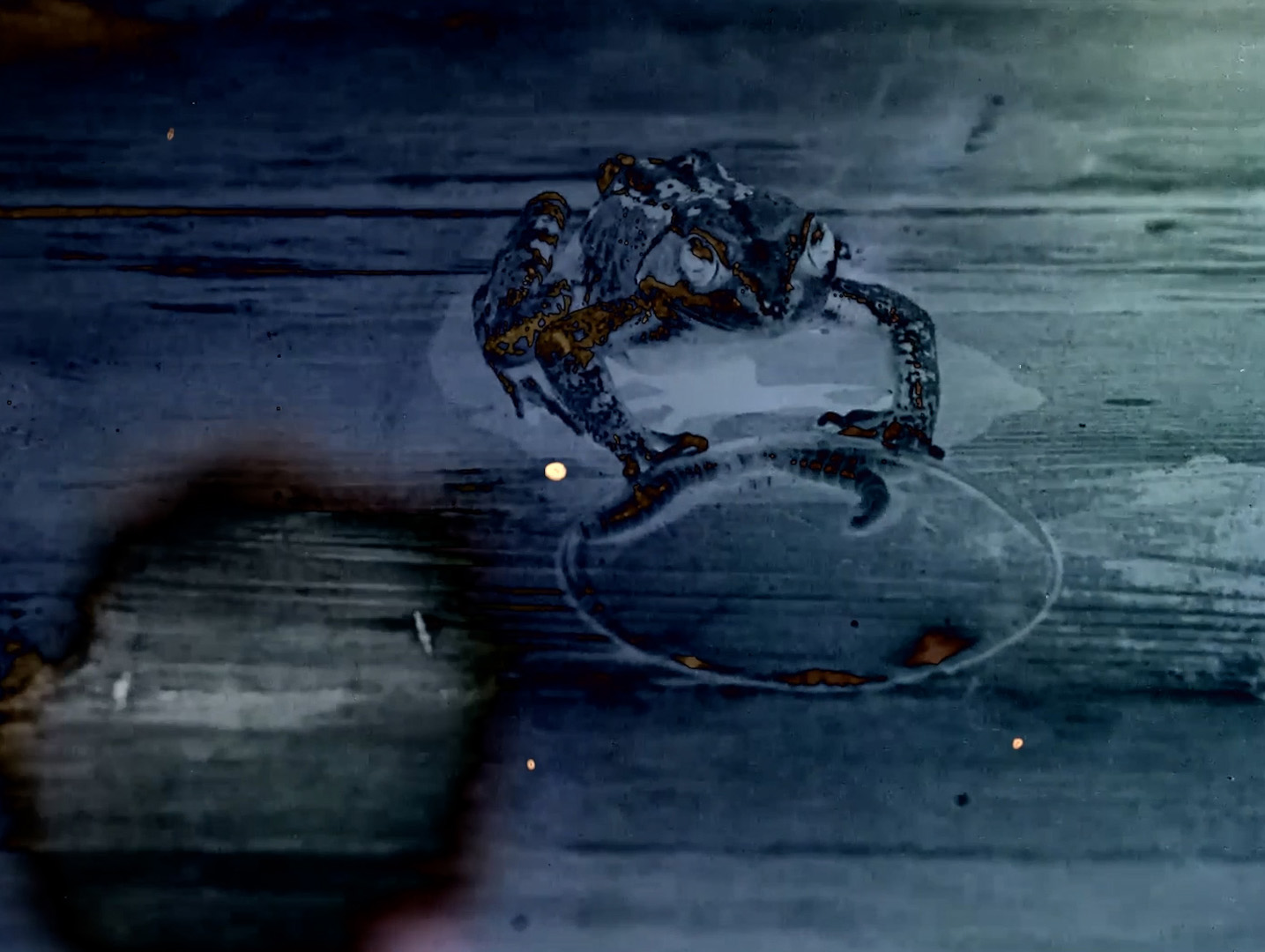
With this crazed symphony, James Richards brings together four years of works to create a hallucinatory experience for the hysteria of our times.
The umbrella name given to the three distinct chapters of James Richards’ latest work at Sylvia Kouvali is perhaps the best way to describe the feeling that flows between the varying images. Moving from structuralist to figurative, to historical and to performative, Fevers is one of the best emulations of filmic febrility in recent years, calling back to legends in the field, such as the late David Lynch. But what makes it so effective is its connection to the real.
The first chapter, according to Richards, rests on two classic references within avant-garde film and literature: Tony Conrad’s The Flicker (1966) and Marguerite Duras’ Les Mains Négatives (Negative Hands, 1978), the latter of which has recently received its first official English translation. The intersection of the source texts that Richards’ is identifying is a return to the basics of communicating through representation; while Duras tells a story of early man using pigments and their bare hands to leave images of faces in granite walls, Conrad’s structuralist film is, according to Richards, reduces cinema ‘to its most elementary principle: alternating fields of light and darkness.’ In this first chapter, the surface of the screen becomes a site of craft, of light manipulations.
The return to rudiments is continued into the next chapter: a single shot pans across a wall, where cracks and potholes form human faces in the rock. From these primitive beginnings, the second half brings what Richards describes as the “back to basics” approach into the contemporary moment: a palimpsest of images of performance art, symbols of violence and digital Cubist renderings. Richards finds the origin in Duras’ and Conrad’s rudimentary approach present in these more modern images, as well as where they ought to be born in mind. In his notes for the show, he laments:
‘The last few years have been brutal: consuming streamed images of war and genocide, making art and teaching amidst the German state’s bludgeoning doublethink. Arts funding across Europe cut to siphon more into defence. Wondering what it means to live from project to project, weaving poetic abstractions while absolute events are piped into our pockets in real time.’
It is worth quoting Richards at length here because this context—as well as the fact that Richards is aware of it—adds the necessary weight to Fevers that makes it so striking in the present day. The images of boar eating carcasses, a visceral close-up of the human eye, or even just the use of strobe lighting become metaphors for the over-stimulating, over-saturated nature of social media, where the presence of all the world’s jubilations and horrors all at once is nausea-inducing. Indeed, with the recent legal recognition of its addictive qualities, the “sickness” of social media is becoming all the more apparent, making Richards’ project all the more frightening.‘The feverish figure resides not in resolution,’ explains Richards, ‘but in the constant negotiation of visibility, where coherence slips away even as it briefly assembles.’
In an age where the line between representation and simulation is blurring, the return to craft, to allegory, to human presence in and behind the frame is increasingly important—Fevers is a beacon of hope that this may still be possible.
James Richards: Fevers is on show at Sylvia Kouvali until 18th April 2026. For more info, visit their website.
Image courtesy the artist and Sylvia Kouvali, London / Piraeus.


