Despite its far-reaching geographical and historical subject, the themes of home and belonging make the eponymous “ground” unmistakably East London, the area in which it rightfully won awards last year.
It should come as no surprise that The Ground Beneath Me, a project consisting of the filmic work Legacy of a Heart’s Injury (2026–) and the three sculptural works that interact and centre on the eponymous cardboard lampshade, should win the East London Art Prize. Bow Arts’ annual prize, awarded to art made in the “cultural hive of East London”, has celebrated a work that sets up vivid lines of memory and culture that spread rapidly out of East London, across the world and back again. Few major works in recent years have presented these ideas so succinctly.
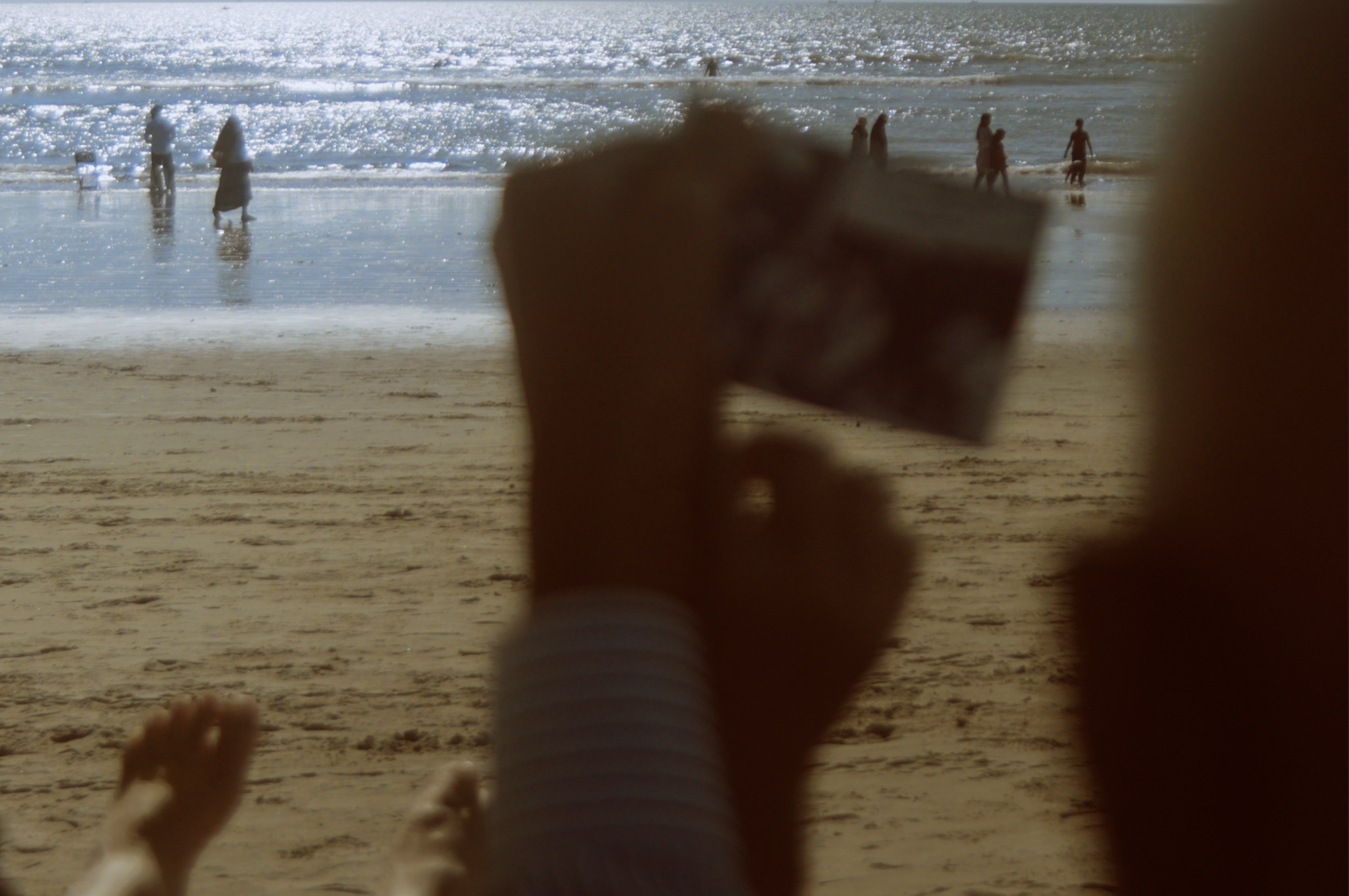
Legacy of a Heart’s Injury opens up this conversation with hesitancy; we see Hoque talking to a friend about their father, who died in the Bangladesh Rifles revolt of 2009. For the majority of the film, we see the two talk—sometimes in a public meeting place, sometimes in a cinema looking at old footage of the father—but we never see their faces. With their backs turned, the deep-dive into childhood memories presents itself with a barrier; the personal ownership over these memories, preserving a cultural specificity which we shouldn’t seek to access. It leads us beautifully into viewing the archival footage of the friend and her father, forcing us to adopt a similar, distanced yet sympathetic view of footage that, despite our privileged ability to see it, we must keep reminding ourselves isn’t ours.
This is also why Hoque puts himself in the frame along with his friend; called back to Bangladesh to attend to his own father, whose health was declining, he too experienced the turbulent end of a political era in the country. The next room in the gallery is a testament to this; again, not to the representation of political turmoil, or staging the dynamics of his family, but to the experience of distance. The three sculptures in this room interact to create a sense of connection across space that viewers, in turn, make about Hoque’s presence, if not physically.
At the centre of the room is Everything I Lived With, all the belongings and furniture he owned and left behind when he was called back, placed exactly as they were in a small, wall-less room. Sculpturalised in this way (and organised to the exact dimensions of the room), the real presence of the objects exposes the various absences: the walls, any concept of location (one would assume somewhere in East London), and most importantly, their owner: Hoque himself.
Questioning the existence of a tree falling in the woods, or of somebody’s father taking ill halfway across the world, becomes irrelevant; rebuilding this scene, translating it through art, memory becomes the plane on which many things exist without us realising. The sculpture speaks truth to the documentary, in the way that our consumption of events in parts of the world we cannot see for ourselves is only possible when we filter it down; in the same way we don’t see the subjects faces, here, we only see the memory, the tree falling over and over again while the wood remains ever sturdy.
It is why the lampshade, entitled The Ground Beneath Me (and perhaps not a feature of Hoque’s room…), is a replica of the General Assembly Hall in the National Parliament Building of Bangladesh. The presence of this lampshade inflects the harsh reality that glows from the objects, mixing it with the glow of memory of a faraway place. It is also why, surrounding them, there are framed boarding passes for trips between London and Bangladesh that have been drawn on with coloured pencils.
These passes, collectively entitled Scenes from Departure, are evidence of the in-between space that looms over Hoque, as it does many other immigrant communities living in East London (and indeed across the globe), who hold a diversity of cultural memories inside them. Surrounding the room setup, it feels like they would dampen the melancholy of the space. However, with the colours scrawled all over them, they instantly switch to representing a celebration of this diversity—a celebration that the East London Art Prize exists to promote.
To find out more about the East London Art Prize, as well as what is on at Bow Arts and the Nunnery Gallery, visit their website.
Image: Still from Laisul Hoque, Legacy of a Heart’s Injury (2025). Courtesy the artist.


