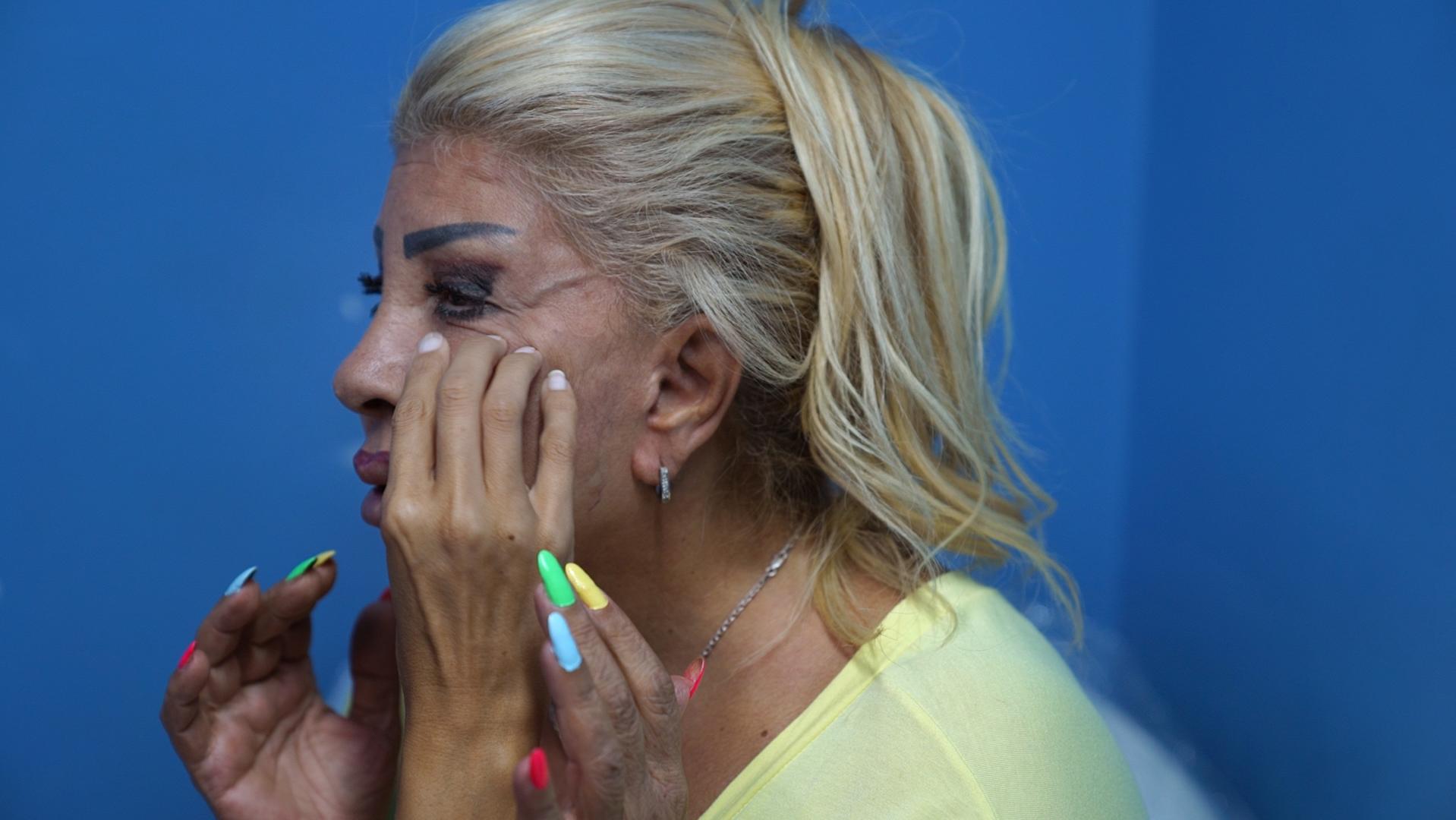
On its fleeting visit to the UK after winning the Award for Outstanding Artistic Contribution at IDFA last year, Omar Mismar’s meditative documentary A Frown Gone Mad brings Beirut’s industrial complex of beautification to London’s ICA. From a single room in a Bouba’s popular salon, Mismar explores the production of war, beauty, and cinema, with botox and fillers as his medium.
Consisting of snippets from many appointments with salon owner Bouba, A Frown Gone Mad soon becomes repetitive. But with the developments in conversation, the successes and failures of Bouba’s upselling tactics, and the variety of reactions to the over-the-shoulder nosiness of Mismar’s camera, we soon find something meditative about these appointments. While some clients talk about the fortune their treatments will bring them, others talk about the attacks on the southern Lebanese border. Bouba, and indeed, the salon, becomes a safe space for people to talk freely—met, more often than not, with her dry, straight-talking responses. Indeed, while she often plays on people’s insecurities to upsell treatment, her approach is always one of indifference, responding with a court wit that everyone receives equally.
What stops A Frown Gone Mad from becoming claustrophobic or monotonous is the curiously Fordian nature of the treatments. The idea that beauty can be sculpted in this way, bought for a handsome (though robustly bartered) sum, transforms the salon into a sort of production line. Beauty becomes less a singularity and more a formula; through the repetition of requests, Mismar shows us the ways that salons like Bouba’s help create this formula, but also profit from it. Her notoriety, which many of the customers comment on, as well as the sheer number of people who sit for her, is proof that this business strategy is no mean feat.
What her clients are looking for is a pre-existing image of beauty, validated by referents and familiarity—much like all image-making. While some of the clients seem reserved about their treatments, some appear as a magnificent pastiche of movie-star beauty. Indeed, it was one client at the latter end of this spectrum (the lady we opened with) who fascinated Mismar when he met her, inspiring him to make the doc in the first place.
But this image beautification isn’t exclusive to Botox and fillers. Indeed, the look that Bouba’s clients want to achieve comes predominantly from social media, where images are beautified to the nth degree. A lot of her clients talk about Beirut-based pop star Haifa Majic, whose breakthrough in the late 2010s was as much down to building a sufficient social media persona as anything else. What’s more, Mismar intercuts shots of clients with inserts (both real and parodied) of Bouba’s WhatsApp stories that advertise deals at the clinic—Mismar tells us after the screening that this is her main advertising platform.
But how was this so effective for Haifa Majic (whose name is now atop a makeup brand)? Where did it come from? In the repeated sequences of Bouba’s clients, affirming and reaffirming the standards of beauty with every appointment, we can see the close relationship that cinema has to this beautification, and perhaps even forms its origins. Indeed, many of the clients comment on the camera and the potential for it to make them famous.
Mismar draws similarities to the long, industrial history of beautiful imagemaking in cinema, which now jumps off the screen and into the facial muscles of viewers in Beirut and around the world. But there is another, uglier side to this industrial complex that finds its way into A Frown Gone Mad: war. At the time of filming, tensions on the Southern Lebanese border were rising (especially in the second half of the film, which was filmed after October 7th). It would be too easy here to comment on the industrial comparisons between Bouba’s fillers and the military’s firearms—indeed, clients regularly do this for us when they comment on the conflict south of their country.
What Mismar shows us instead is the reality of living so close to a conflict that itself is beautified on social media, reduced to headlines and awkward, inhumane diplomacy. At such a micro-level as Bouba’s clinic, the commentary is comparatively wry and stubborn: she advertises that her prices have “bombed” while telling anxious clients that Lebanon and its allies will win, with no need for an explanation. The ability to cross into social and political topics from such a personal level is particularly impressive in the film; just like one of her clients says of Bouba, Mismar ‘takes the pain from inside and works on it from the outside.’
While its visit to the UK was fleeting (premiering at Sheffield DocFest before coming to the ICA), it nonetheless left a lasting impression with its critique, but foremostly with its window into the world of Botox and fillers in Lebanon’s capital. A Frown Gone Mad is as much a treat for the curious as it is a comment on beauty, image-making and war.
Image courtesy of the filmmaker.


