Several fairies adorn the expansive windows of Josh Lilley Gallery, hovering in the sun. Their small figures are suspended before various gaudy shades of sateen curtains within the alcoves. Some hold tiny lanterns and bulbs that flicker against the sheen of the glass and drape of the fabric, others are swathed in elaborate adornments. Under scrutiny, however, the finery of the window dressing signals an incipient collapse. The PLA sprites have torn holes across their wings, jewels embedded in their eyes, the drapery weighing them down becomes indistinct, appearing more like bodily matter – the magical image dissipates – and what’s left is a frozen state of uneasy suspension.
For her second solo exhibition with the gallery, Rachel Maclean has cast her discerning technologically minded focus towards the ever-arriving spectre of AI, and the way its presence within our contemporary moment has reshaped societal perception of creativity, authorship and autonomy. Through digital paintings, sculpture and film, Maclean ruminates on this malaise by peering back through the looking glass to a recent moment of prophetic change: namely the industrial revolution, the widespread use of the microscope, and the resultant “Fairy Mania” that gripped Victorian Britian. This attraction to a folkloric past was characterised as a recursive public want toward a romantic past world, free from industry and technology, as the churn of their society advanced forward. And so, to 2026 where the rolling news cycle is beset with the latest woes and warnings surrounding AI, and where its presence within the arts is so often instantly derided, Maclean deftly handles this weight across the works in exhibition.

Her approach to physical production is shown to be every bit as fastidious as the worldbuilding contained within her moving image works. A Thumbprint of Light (all works 2026), controls the entrance of the gallery, the image, digitally printed on canvas, tessellates dayglo steampunk imagery with various adornments of resin and glass across its richly worked surface, all set within a corrupted Barbie Dreamhouse altarpiece frame, assembled from sections of green, white, blue and shiny peach 3D-printed PLA plastic. The black and gold palate of the printed image lends it an eerie celestial quality. The antecedents of early AI image generation software’s abound in its arrangement, yet the work (and indeed the exhibition more broadly), does not feel like a deriding polemic against the deployment of this ‘dirty’ technology, but rather suggests a series of tentative steps toward new forms less prosthetic, forms of engagement.
Elsewhere, both Observations Upon the Artificial Eye and On Certain Cases of Acquired Ocular Resemblance take on the aura of religious reliquaries, versioned by Maclean again in crisp PLA plastic. The latter features several fairy scientists gathered around a lamp in acts of calculation and observation. The sculptures are themselves holding sculptures: certain elements of the moving image works are reproduced in miniature, small areas of the piece are beginning to show that characteristic AI collapse, where bodies and settings become indistinguishable from one another. Encountering these works, before viewing the film included downstairs, leaves their relationship hidden, but this charged ambiguity feels productive.
A green slime pools across some of the works’ surface, also in PLA, this is the sole allusion from Maclean that feels blatant, AI slop literally. Particularly given the subtleties and intention across the rest of the works. Then again, Maclean has never been an artist embodied by their restraint. In the lower galleries, A Corpse in Flatulent Water, positioned just before the film work reads as a final warning. The fairies are now a mangled pile, each form becoming amalgamated into one, whimsy into a grotesque.

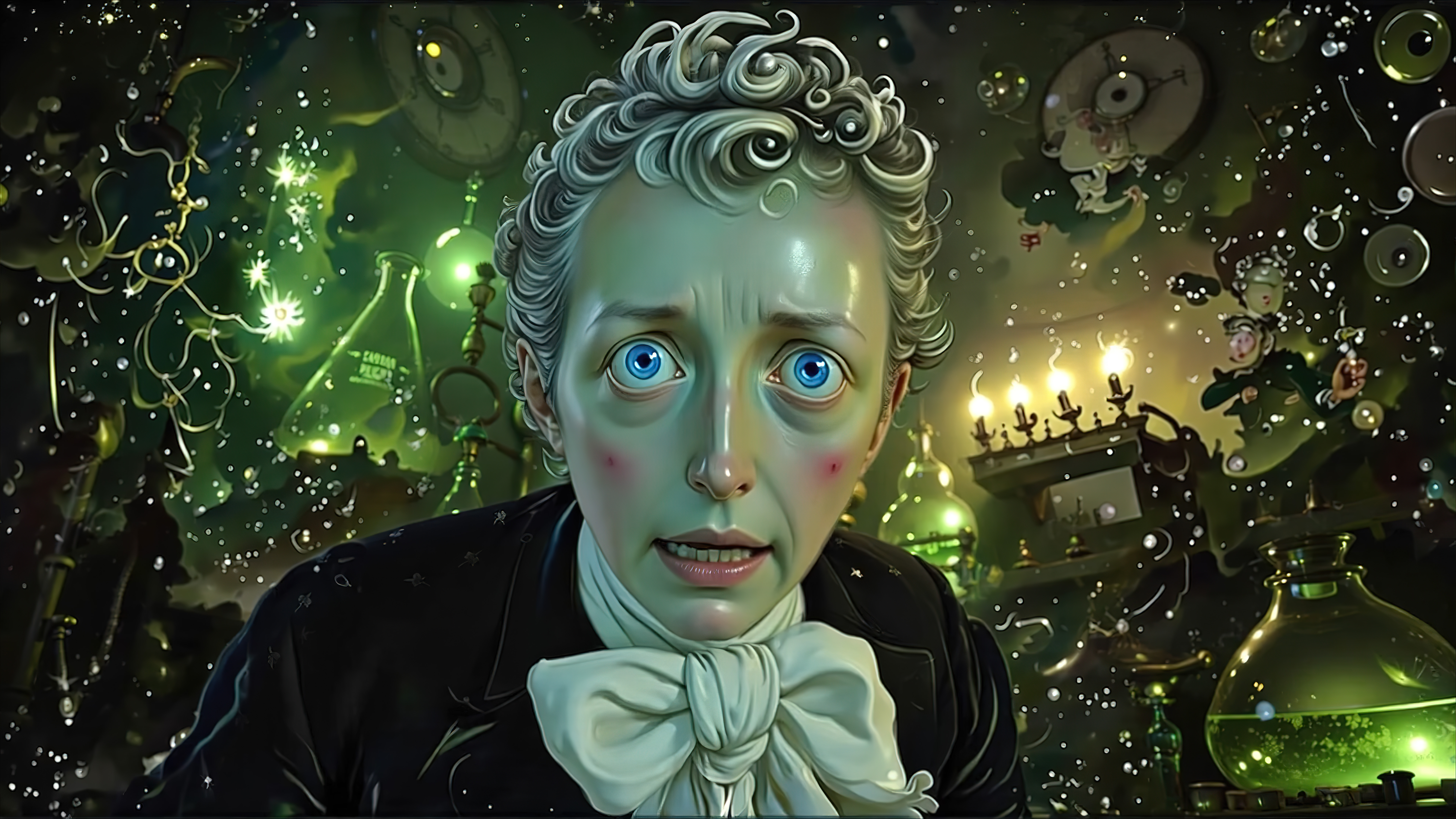
Held behind further sateen curtains in the basement, the heart of the exhibition is the film work They’ve Got Your Eyes, produced in collaboration with an AI double trained on Maclean’s previous output. Typically the sole performer within her films, here Maclean complicates her own authorship, creating a work in which the distinctions between the recognisably human, and the synthetic becomes volatile. I’m reminded here of the recent Rachel Rossin exhibition, ‘The Totalists’ at Albion Jeune London. The artist created an AI that was feed on a dataset of her own artistic work, beginning with a drawing made when she was five, it generated a stream of perpetually evolving images, which Rossin used as a basis for new paintings. In doing so, comparably to Maclean, Rossin successfully arrived at a body of work that felt reflexive rather than complicated through it’s associations with AI. In the film, faces flicker between states, identities blur, and the work itself appears caught in a process of continual transformation. Centering on a rivalry between two men who discover how to generate fairies, The film shows these creatures capable of producing objects, texts, and eventually entire buildings as their powers expand, endlessly regurgitating and reflecting back the knowledge fed into them. The analogy is clear, yet it doesn’t feel like a cautionary tale. While it’s possible to read the work as a Disneyfied rendering of the issue, even a trivialisation of it, They’ve Got Your Eyes somehow manages to skirt this fine line without becoming didactic. Only, as with the sculptures, the viscous presence of literal slop nudges the work towards that territory.
With their brittle plastic form, the exhibited sculptures take on the quality of merchandise, as though the works upstairs are official tie-in products: the They’ve Got Your Eyes playset, now with glowing screen! Yet this is so innately Rachel Maclean, it feels on brand. There is a pleasing juxtaposition seeing these historically inflected forms rendered in this cheap, contemporary material, one so closely associated with a new technological economy and, arguably, another form of automation. After all, these works imitate the language of classical sculpture, and a significant portion of their production has been outsourced to a machine.
Reflecting on this material choice, introduces complications that perfume the edges of the exhibition. While Maclean is clearly interested in the aesthetics and logics of technological production, the material and environmental implications that underpin these systems remains largely unspoken, outside of lurid green slop and some litter polluting the environment of the film work, and across the sculpture. The energy demands of AI, its vast water usage, and the ecological cost of the infrastructures that sustain it, sit intentionally outside of the frame.
Whether this absence is strategic or inadvertent is unclear, but it remains a notable omission within a practice that is typified by its atonement to the cultural consequences of emerging technologies.
Rachel Maclean: The Enchantment of Reason is on show at Josh Lilley until 1st August. To find out more, visit their website.
All images: Rachel Maclean, They’ve Got Your Eyes, 2026 (still). Co-commissioned by FACT Liverpool and Sonica Glasgow, with support from 1646 Experimental Art Space, The Hague.


