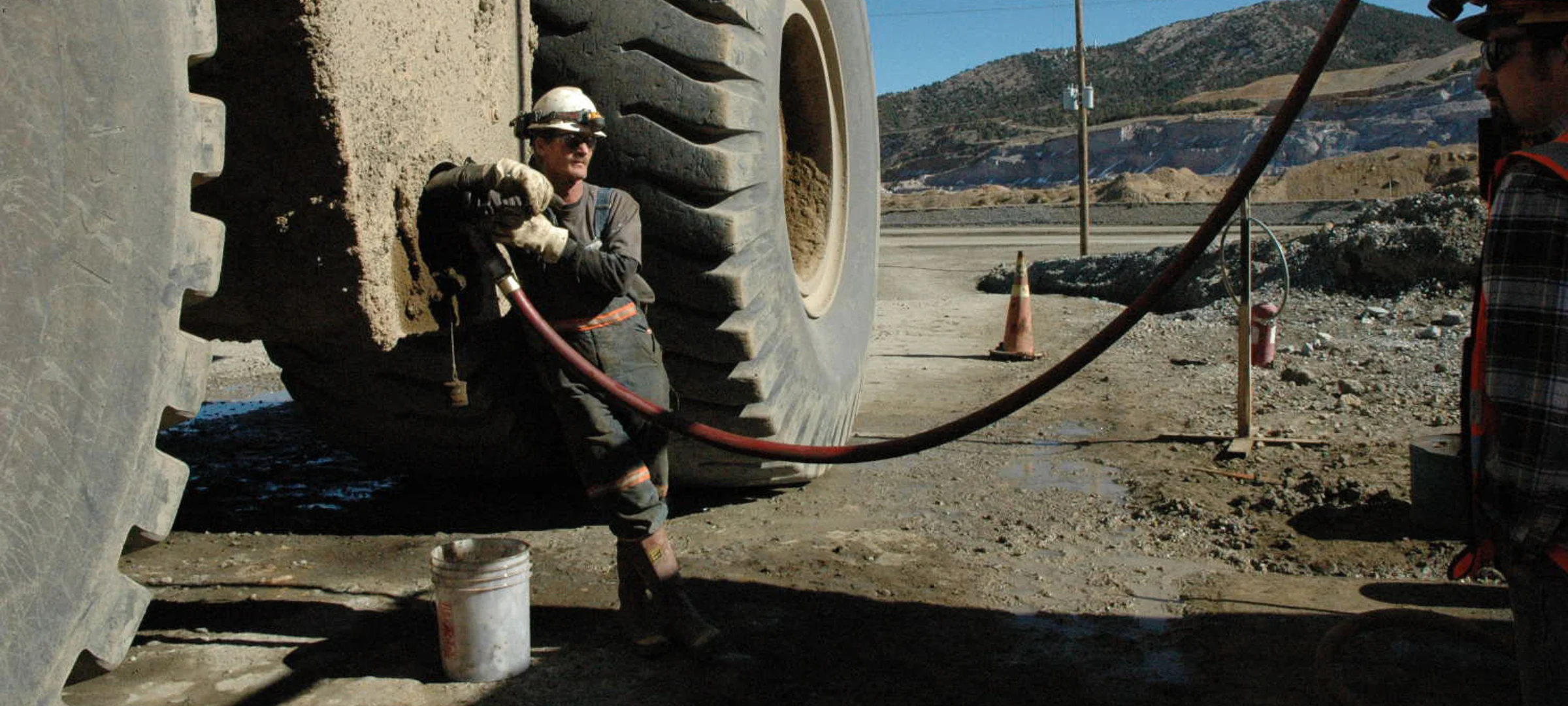
In conjunction with their ongoing exhibition Lucy Raven: Rounds, an investigation into landscape shaped by industry and extraction, the Barbican screened a double bill of the filmmaker’s seldom circulated China Town (2009), and Jean Luc-Godard’s Opération béton (1955).
Much like Raven’s latest film Murderers Bar (2025), receiving its UK premiere at the Barbican exhibition, China Town makes material its guiding protagonist as we trace its journey through landscapes across the globe. But where the aerial drone perspective of Murderers Bar is fluid and dynamic as it follows a river’s return to its once severed environment, China Town’s is static and fragmented. Composed of 7000 digital photographs taken by Raven (distilled from the 70,000 originally taken for the project), the film is a meditation on the global life cycle of copper, as it is extracted in Ruth, Nevada, before being refined in Tongling, China.
The film begins with a controlled explosion in the copper mine, the first and most spectacular of many fracturings of the landscape engineered by the copper industry. Raven’s photos are presented in quick succession, creating a flickering impression of movement in stop-motion fashion and revealing the tension between motion and stillness underlying the extraction process, thus imitating the modular movement of industrial production, a highly compartmentalised and alienating process.
The montage denaturalises the processes of extraction, and unlike an episode of How it’s Made, is not didactic, but instead holds the process up for examination. Shutter noises remind the viewer that they are in the voyeuristic role of observer, always watching a process captured by camera technology. The excess of photos speaks to not only the sheer volume of waste created by extraction industries, but also the excess of data required to map the land, survey the terrain, and locate copper deposits before extraction. The camera is not only a means of observation, but also of control, which transforms landscapes into property.
By choosing to depict extraction via a series of still images rather than the moving image, China Town articulates a Barthesian death-in-life logic. China Town reflects on how big industry captures and freezes material in process, dividing and conquering the commons in a way that forecloses the natural contingencies of Earth’s own unique processes. The only sense of liveness we get throughout the film is restored by the on-site audio recordings. Though at odds with the static visual experience, sound maintains a sense of contingency and unfixity, which is lost in the still image; the sound/image dissonance attends to this ghostly experience.
It is this capturing of material that then goes on to animate the product we arrive at in China: a flashy museum of the Three Gorges Dam, featuring immersive films in surround auditoriums, detailed miniature models of cityscapes and interactive globes, accompanied by a triumphant, Jurassic World-esque soundtrack. Replicas and remakes of the landscape, designed to spotlight how energy is harnessed and distil the million-year history of the Yangtze River into an awe-inspiring display fit for human comprehension and consumption. The museum’s framing of the dam as a symbol of industry’s power to bend material at its will couldn’t diverge any further than Raven’s critical position, which understands the dam not as a feat of mastery, but as evidence of a violence enacted across labour and landscape.
Opération béton (“Operation Concrete”) likewise centres itself around a dam, that is, Grande Dixence in Switzerland, the tallest dam in Europe. Though unlike Raven, who was led to the Chinese dam through documenting copper, Godard’s connection is deeply personal.
Having worked on site performing hard labour for a couple of years, his first substantial film was inspired and funded by the income he made as a worker, revealing a striking circularity between labour and cinematic form; where Godard’s labour gives rise to its cinematic representation, Raven takes the relationship to its logical extreme and bakes it into her film form. His distaste for the experience emerges in a voice-over narration which ironises the optimism infusing the construction of the megaproject.
Complimented by an upbeat orchestral soundtrack, images of the landscape approached from an aerial view are littered with cuts and incisions made by the heavy-duty machinery, and Godard walks us through the exhaustive processes of mining and drilling raw material before it is converted into the concrete required to stop the Lac des Dix in its tracks and generate hydroelectric power. We follow the material up and down the mountain, back and forth across the valley, in a procedure that showcases the complex dance of labour, landscape and machinery as it congeals in the enormous dam.
Godard also attends to the plight of the workers, describing 11-hour shifts undertaken as a victorious battle waged against the “plundered” landscape. Early on in the film, he commences that “operation concrete has begun,” presenting the site as a battlefield and understanding that the infrastructural project, a symbol for post-war modernity, is one that is built on a campaign of militarised domination over the landscape and the mobilisation of an enlisted labour force. Both humans and landscape become victims of the war of “progress” waged by industry.
As the dam transforms the landscape, Godard transforms what was originally conceived as a generic instructional documentary into a sharp consideration of what it means to manipulate material, for both the earth and its human inhabitants. showcasing the violence underlying this process. Together, Opération béton and China Town recentre that material that makes up our landscapes and offer alternative ways of seeing the industrial forces that shape them.
Lucy Raven: Rounds was at Barbican’s Curve until 4th January. To keep up with Curve exhibitions and film seasons, visit their website.
Image © Lucy Raven, courtesy of Barbican.


