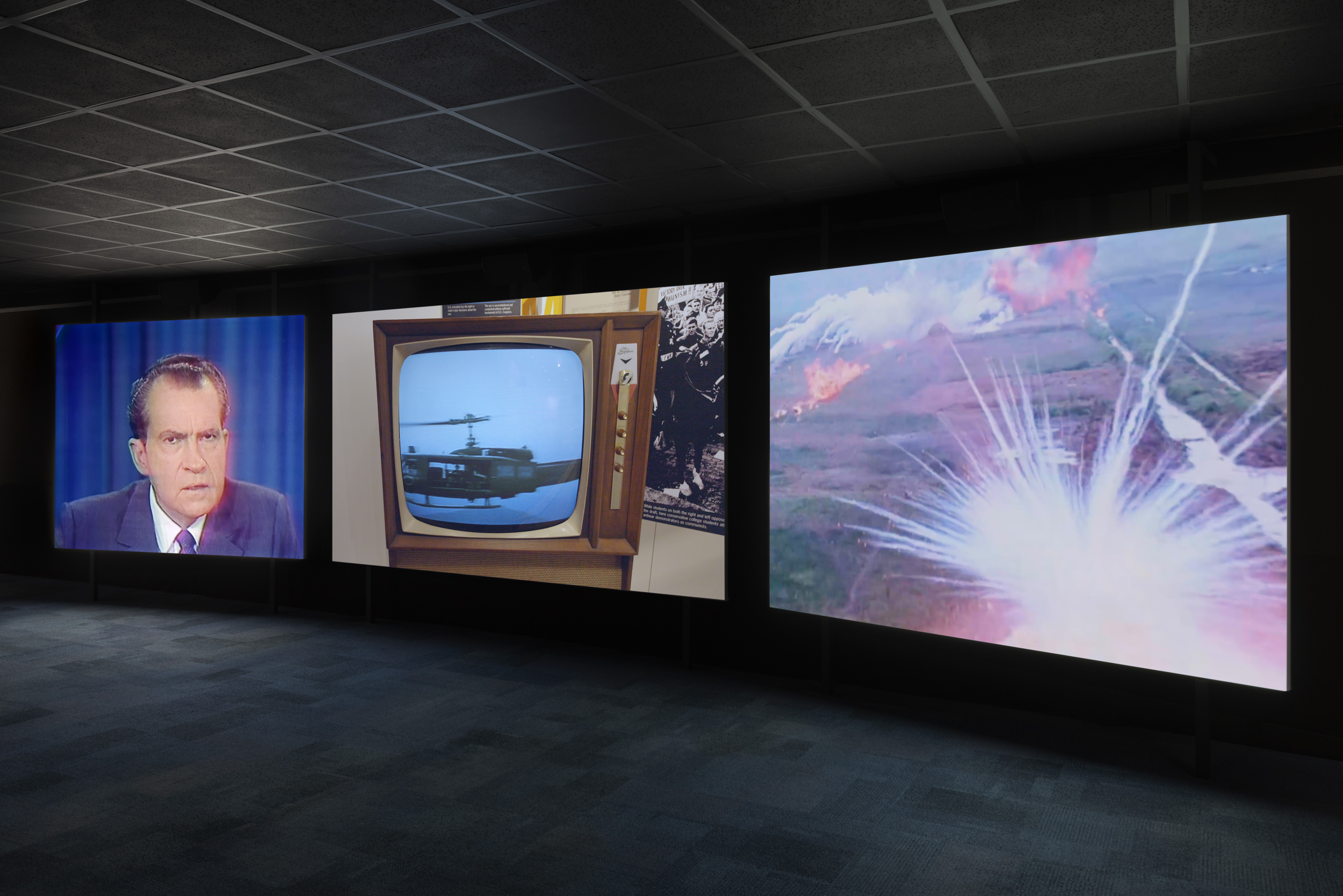
Until the end of this month, the latest multi-screen installation project from filmmaker Naeem Mohaiemen, Through a Mirror, Darkly, plays at Albany House in Westminster, an old office building deep in the administrative centre of the UK. The building is opposite the Ministry of Justice, and used to house the British Transport Building. But this autumn, Mohaiemen uses it to recount in comprehensive detail a period of history defined by student uprising, whose power brought the morale superiority of the law into question.
Spring 1970: In the wake of the Civil Rights Movement and the Vietnam War entering its second, grim decade, tensions at home in the US are rising. Following several years of student uprisings in Europe, young Americans are getting restless, frustrated by Richard Nixon’s domestic and foreign policies. This all reached a head in May, when police shot dead two groups of students at Kent State University, Ohio, and Jackson State University, Mississippi. The former was during a demonstration on campus, while the latter occurred some hours after a demonstration, outside a dormitory. It’s worth noting that Jackson State is a historically black university, which becomes a subject of inquiry for Mohaiemen as much as the demonstrations themselves, and also the Vietnam War campaign.
Naeem Mohaiemen builds this evidence board, connecting these events to testimonies from their actants in the present day, on three separate video channels, curved inwards on the audience. Focus, against what one might expect, is rarely on the central channel; to keep up with this web of events at home and abroad, your eyes need to be in constant motion. We see the individual perspectives on the issues, connecting American students in the 1970s with Vietnamese citizens, in turn with present-day youngsters helping to memorialise the shootings.
But this is also where the arguably activist, didactic nature of Mohaiemen’s work comes in; through the young people helping to memorialise the events 55 years after the fact, Mohaiemen reminds us that they too are living through a time of conflict, both at home and abroad. History is undoubtedly repeating itself, and it is clear that Mohaiemen, by making us work tirelessly to make connections between events in his film that sprawl unpredictably across three channels, is also making us connect this history to our present day.
Indeed, talking to Artangel—the arts organisation that commissioned the film—Naeem Mohaiemen claims that the multi-channel approach is to help us “recognise” and “mark contradictions.” He juxtaposes a speech by Nixon or his divisive VP Spiro Agnew on peace-keeping and the danger that students pose with footage of napalm bombing in Vietnam. Somewhat ironically, however, the contradictions seem only to go as far as Mohaiemen’s screens; mapped onto present-day America, the resemblance is uncanny.
Mohaiemen is also hesitant to recognise institutional memorialisations. While the film semi-mocks national memorials to the “victims of communism,” we spend a lot of time with events set up by former students of Kent and Jackson State, understanding the importance of these memorials and the strong communities they create. While many have theorised on institutional memorialisation, specifically on the paradox of “remembering to forget,” these independent, community-led events keep the memory of the tragedies alive, the lessons fresh in the minds of those Americans who will be prepared to use them when the time is right.
Mohaiemen’s film, then, is a sort of memorialisation itself. Mixing filmed images with years of archival footage, Through a Mirror, Darkly brings to modern audiences a level of understanding of the issue that we may not have otherwise gained. Indeed, next Spring the film will travel to The Wexner Centre for the Arts in Ohio, where it’ll no doubt reach many who know the events that took place in May 1970 all too well.
Mohaiemen’s Film, then, also seems to bring the past into the future, memorialising not only the events but the archival footage itself. Someone else who was particularly interested in this idea, as it pertained to Richard Nixon’s America, was French philosopher Jean Baudrillard. At the end of his seminal 1983 essay ‘The Precession of Simulacra,’ he makes a case for the foregrounding of images and signs over reality in the modern age, with the example of Watergate taking up the last few pages.
As is particularly the case for the Jackson State victims, history tried to erase these shootings, replacing them with the moral good of Nixon’s administration. Through his three screens, Mohaiemen shows us the amateur footage that pieces together the truth of the events, alongside Nixon and Agew’s rhetoric, to break down the simulation and unveil the truth. For Mohaiemen, the “moral good” is here, in understanding and memorialising the smaller voices that televisual simulations elide.
While the events Mohaiemen documents are in the past, across the Atlantic Ocean, one can’t help but feel it pressed against your face as you walk out of Albany House, into the concrete citadel of Westminster. As history repeats itself across the world, Mohaiemen’s film reverberates against the high walls of the ministries, reminding us of the New Testament verse the film is named after: Corinthians 13:12, “through a glass, darkly”. As St Paul explains to Christ’s followers of heaven, these events are only clearly visible to us when they’re in the past, when we can best use them to inform our future. Extended by popular demand until the end of November, I hope that many will be able to witness this past, so they too can better mobilise for a brighter political future.
Naeem Mohaiemen’s Through a Mirror, Darkly is showing at Albany House until 30th November 2025. For more info and to keep updated with Artangel’s installations, visit their website.
Image © Naeem Mohaiemen, courtesy of Artangel. Photograph: Thierry Bal


