Concept artist Ilê Sartuzi brings A Crime, a Confession and a Trade, the culmination of his Sleight of Hand project, to NıCOLETTı. A two-channel video installation that played at São Paulo’s Museu de Arte Contemporânea a couple of years ago, Sleight of Hand left a lot of critics confused; not only asking “did that just happen?“, but also wondering why he would so willingly, and openly, confess.
For A Crime, a Confession and a Trade, Sartuzi has filled the intimate backroom space in NıCOLETTı’s Paul Street gallery with artefacts from the Sleight of Hand project, from printouts of email correspondences with the British Museum, to CCTV screengrabs, and other related artefacts. The collection maps out the project, the inspirations and motives behind it, as well as reflections on the ethics and philosophy behind the theft. Most of all, however, it exhibits Sartuzi’s unwaivering confession to the crime.
But confession seems to be the point here. In fact, for Sartuzi, it is a genre in which he situates his work. Austerity is pulling us further away from the “great” Britain that the British Museum represents. Sartuzi’s project represents the variable value at the centre of the crisis. Indeed, the wealthier one becomes, the more ambiguous one’s fortune becomes. It doesn’t matter if it’s stock value, or the prescriptivist opinion of an art historian’s valuation. The morality of theft, then, becomes muddied.
To help understand this alarming assertion, the artefacts in A Crime are accompanied by references to Robert Bresson’s Pickpocket (1959). An old TV playing a minute extract from the film every 60 seconds. In Pickpocket, the protagonist’s crimes are rarely explained, outside of the sheer desire to commit them. Sartuzi mentions S. Ceilidh Orr’s analysis of the film as an entry point to his interpretation. Orr compares an opacity of character with a transparency of narrative. This is to say that, while we see him commit the crimes, we can’t understand why. The belief is that it is merely for the desire to steal, hence the confessional nature. Importantly, it is not for the value of the object.
Clearly, Sartuzi has ascribed value through the process of theft itself. A page from Sartuzi’s notebook recounts an exhibition opening in Central London, where everyone “looks more or less the same.” In this small crowd of people, Sartuzi becomes obsessed with a man’s watch, and the need to touch it. His feelings don’t seem kleptomaniacal. Indeed, he doesn’t explicitly talk about having it, more about the lead up and the act of stealing it. Instead, he seems to pity the man. In a room full of identical watches, what would add value to this particular watch—the value, presumably, that this man paid good money for—would, paradoxically, be that it was stolen.
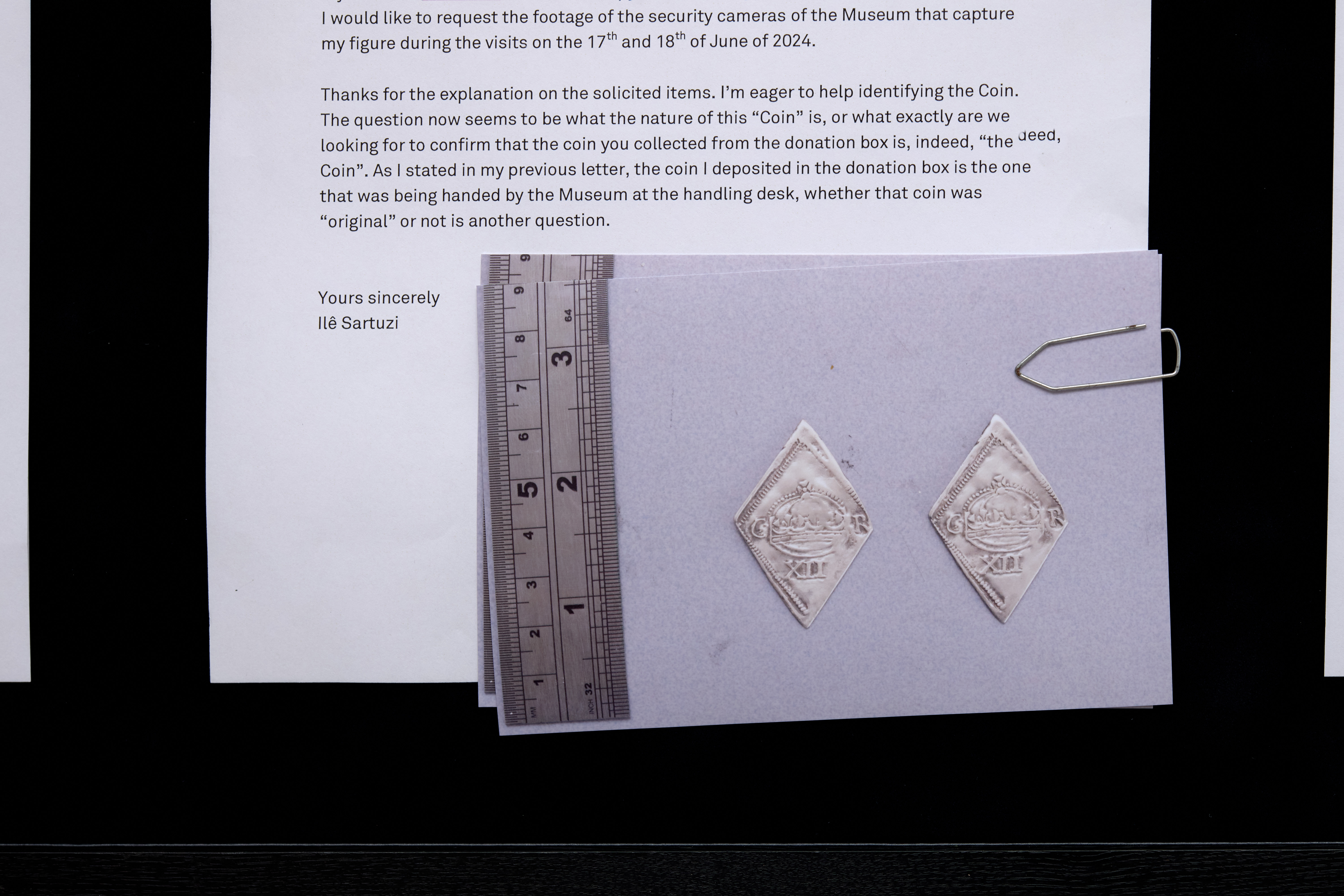
The fact that the object Ilê Sartuzi eventually does steal is a coin is of no small significance either. In his notes on the 1645 Newark Shilling that he decided to have for himself, Sartuzi goes into detail about the weight, purity, and value of the coin. So, in correspondences with the British Museum, exactly what is the value of the thing they’re discussing? The gravity of his theft? When Sartuzi put the real coin in the museum’s donation box, how much was he donating? Realistically, these questions don’t have answers. But given the very real fortune that the British Museum governs, they seem to be profitting from this this lack of answers. However, this doesn’t mean that we shouldn’t ask the questions. Sartuzi’s pointless theft has value elsewhere, in exposing cracks in the British Museum’s integrity, above all else.
Following the room clockwise, the final artefact we encounter is two identical coins, with two identical contracts on either side, outlining the sale of each coin. What is the value of these two coins, the subject of such a project, if there are two? Kelly Reichardt’s latest film, The Mastermind, augments that subconscious question, “What would happen if we unhooked a masterpiece from the wall?”. Does this change here, where one is a replica? And in the context of a project that is debasing the concept of value in art? Is it speaking to Reichardt’s film, to the misplaced ascription of value on an object, rather than on the act of theft itself?The answers to these questions, it seems, do not lie in this exhibition. But maybe it’s because Ilê Sartuzi has finished his job; maybe it’s up to the British Museum, with their precarious history punctuated by theft, to finish this ethical quandray. One of a few pieces of original “artwork” in the show is a large print of a still from Pickpocket, where somebody has just caught the protagonist in the act, the word “DEAL!” scrawled over the top. Is stealing from thieves okay? Ilê Sartuzi has held up his end of the bargain by simply opening up this question; it is now up to us to decide.
A Crime, A Confession and a Trade is at NıCOLETTı until 1st November 2025. To learn more about the exhibition, as well as other events at NıCOLETTı, visit their website.
Image © NıCOLLETTı


