Amidst plans to strip down Gaza to rebuild a ‘Gaza Riviera‘, Sepideh Farsi’s documentary Put Your Soul on Your Hand and Walk strips down the lies entrenched in mainstream media about the war to rebuild a new, more constructive form of communication with Palestinians.
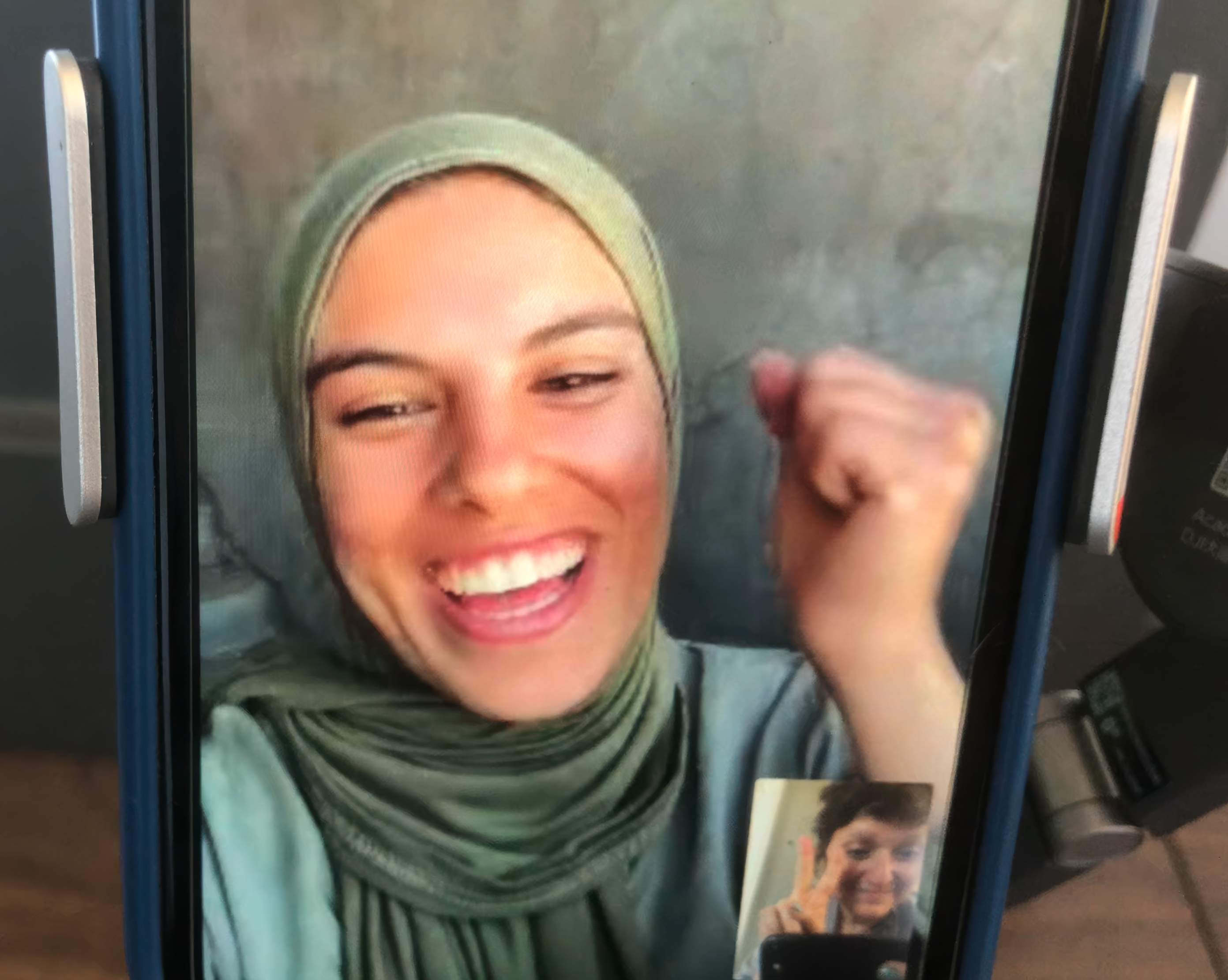
Pivotal in all this, from the ‘Gaza Rivieria’ to recent investigations into acts of genocide, is media coverage. For many months Western media has sought to elide Palestinian voices and allow for this purported genocide to take place. But there remain glimmers of hope; while Western media creates blockades of information as strong as those to aid, alternative news sources still pierce through. Farsi’s documentary, a series of video call conversations with Fatima Hassouna, a photojournalist operating inside Gaza, is one of these; while Trump uses AI to simulate what Gaza should look like, Farsi and Hassouna are documenting what it does look like right now.
What results is a striking documentary that, although slightly reduced to concept, sends a poignant message about the power of media in this conflict, for better or for worse. One that, in response to a screening in Cannes Film Festival’s ACID programme earlier this year, Isaac Feldman called “the most important film of this year’s festival.”
This is not to say that Put Your Soul on Your Hand and Walk flips the issues of the newscycle around Gaza on its head, becoming equally as unnuanced and didactic. Instead, we witness an ambivalence towards war you can only detect in free, open conversations. Hassouna’s lively spirit that endures as she shows us the devastation around her, is not contradictory because we know, through the rapport she has built with Farsi and with us, that this is daily life for her; unpacking the way she wants to stay in her homeland, while also dreaming of visiting Rome, is the type of nuance that is lost in the mainstream newscycle around Gaza.
Turning conversations across thousands of miles of land, sea, and many blockades into what feels like a chat around a table is baked into the making of the film; originally intended to be filmed in Rafah, the conversations over video call were in response to the physical barriers put in place at the Egypt-Gaza border. Clearly, however, the use of video and sound in this way aligns better with the Farsi’s documentarian efforts. As Farsi recounts more and more attacks that have happened over the last couple of years before, moments of uncertainty are amplified; her dial tone drones on that little bit longer, the dread of the “reconnection” screen growing ever stronger.
But then, on the flip side, the sound of keys, seemingly the only sound that travels from Gaza to our non-diegetic ears, transcends the distance, alleviates our feeling of helplessness as we remember that just having this conversationg with Hassouna is the key to unlocking the truth.
The film’s title, then, takes on a whole new meaning; Hassouna, a photojournalist in Gaza whose photos are shown frequently throughout the film, uses the phrase “you have to put your soul on your hand and walk” when talking about the dangers of walking outside while drones fly overhead. But we only know this because Hassouna shows us, recording it over the phone or with her camera, doubling the danger of attack she faces. Her “soul” here is not only her life, but her cameras, which are tools as dangerous as they are necessary to tell her story.
There is still, of course, the presence of a privileged distance. While the film transcends the physical as well as the digital boundaries between us and the people of Palestine, we are certainly not there, and while this middle ground is important as an alternative form of communication, there a points throughout the film where our privilege is made clear to us. Indeed, Hassouna frequently points out how lucky Farsi is to be travelling the world, something she can only dream of.
We are reminded that we too used our freedom of movement without fear of attack to gather in the cinema to watch a film about a far away land; we too have found convenience to ourselves in placing the issues in Palestine into a box (or in this case, a phone screen) so that they are more easily digestible. The real change that a film like this can create is questioned.
But the film’s success at Cannes answers that question for us: near the end of the film, we are given the pleasure of seeing Farsi break the news to Hassouna that her film is being included in the ACID programme. They discuss her travelling to the festival, so as to complete the loop; turn the digital unity into physical unity by meeting Farsi and her fans for the first time. But this is before we are told that, soon after, Hassouna and her family were killed in their sleep during an Israeli airstrike that targeted her building. In response, ACID released a statement claiming that, even though the film will now be received in quite a different way as was originally intended, “all of us, filmmakers and spectators alike, must be worthy of her light.”
Perhaps this is why Feldman calls this the most important film of the festival this year. Farsi has managed to weave the telling and the showing of what is happening in Gaza so perfectly, creating a tragic but very necessary film that lives and breathes through the conflict like few that have come before it.
Put Your Soul on Your Hand and Walk is in cinemas from 22nd August 2025.
Image © Rêves d’Eau Productions


