“You go for the obvious. It’s not like you’re going for the obvious, but that you don’t want to be afraid to confront something head on. You don’t want to talk about it around the corner”, said Charles Atlas in an interview with Performing Arts Journal in 1997. In challenging the conventions of modern dance through queer sensibilities, Atlas suggests that artistic expression and ambiguity need not be at odds. This musing might equally be read as a précis of Atlas’ moving-image practice across four decades, now folded into three reels across two floors at Champ Lacombe. Presenting 15 works from 1970 to 2010, the exhibition illuminates not only the permeability of Atlas’ visual grammar, but also its propensity to spill beyond the frame.
Tableaux of Mayonnaise #1 (1973), stretched upon nine billboards throughout London, blazon choreographer and Atlas’ long-time collaborator Douglas Dunn as he emulates Édouard Manet’s painting Boy with Cherries (1858). As Dunn twitches his lips and squints his eyes, the cityscape, too, becomes subjected to Atlas’ penchant for mischief.

A chance encounter? Perhaps, yet there was little inconspicuous about it. This theatrical spontaneity is summoned from the first glance, as an unsuspecting passerby could easily stumble upon the flickering images behind the gallery’s window on the Bloomsbury street. What first catches the eye, however, is as much a matter of chance as of timing. For me, it began with Atlas’ Self-Portrait (1972), made while he was touring with the Merce Cunningham Dance Company. With a Super 8 camera propped in front of a three-way mirror, one observes the artist observing himself as he toys with the angles of the hinged panels. As his gaze wanders between the fragmented images of himself, the viewer is equally caught within these fractures. Brief moments of reciprocity come into being when he turns towards us—only for his face to recede into shadow as the light falls onto the mirror instead. Yet this sublimation of the image takes on many guises in the works that follow. Grand Dance of the Jolly Three (1973/2010), for instance, collages D. W. Griffith’s The Musketeers of the Pig Alley (1912) and colour and black-and-white footage shot by the artist himself, as Atlas’ dancers mirror the movements of Lillian Gish. Between cuts and vertical splits, the work conjures a continuity across time while revering the cinematic vernacular.
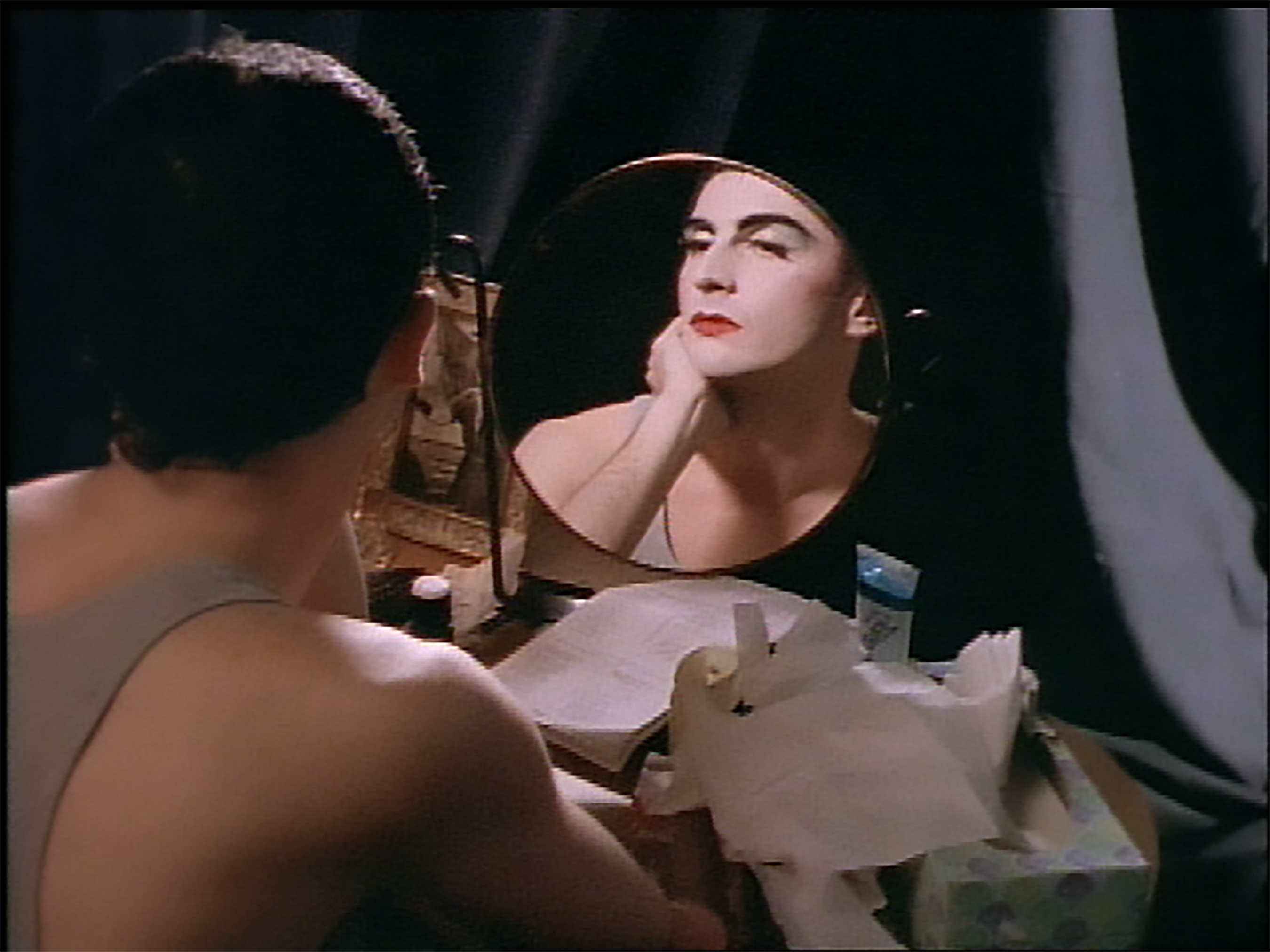
From the private encounters of images with themselves and their histories, Butcher’s Vogue (1990) turns to the more familiar idioms of its milieu. As a satirical homage to Madonna’s ‘Vogue’, Atlas’ riposte, shot in New York’s Meatpacking District, follows two sex workers (played by Gina Vetro and Connie Fleming) who lure and rob a john (Joseph Lennon). While the 24-hour restaurant Florent is recast into an arena of queer pageantry, the two fugitives, joined by a troupe of dancers, are eventually held at gunpoint by the pursuing cop (DJ Keoki). This final stroke of misfortune, reverberating with Madonna’s “Vogue, vogue, vogue…”, leaves the spectacle suspended somewhere between exuberance and unease. Such tension is echoed in Mirror (1991/2026) and Hapi Phace (1991/2026), where the lip-syncing figures, now inhabiting the boudoir, voice a defiant melancholy through the making and unmaking of theatrical personae. It is an immanent poignancy that bears witness to the harrowing realities of the HIV/AIDS epidemic, yet stutters, in its affective desire, towards revelation. As John Kelly gradually removes his makeup in Mirror, the camera draws ever closer in tandem with the song’s mounting dramaturgy. The anticipated moment of closure, however, only gives way to his final gesture of turning the mirror away.

Where, then, does this search for interiority lead? A turn down the spiral staircase unveils the gallery’s underbelly, where two projections face each other obliquely. No longer confronted by a single screen, I inhabited the space between two fields of vision, as though the mirror had been turned inside out. The one on the right gathers four of Atlas’ silent shorts. An exercise in looking down and looking closely, so it seems. Besides Ride (1970), Water Reels (1971) and Vegetable Show (1971), where Atlas guides one through the prosaic textures of life, Floor (1974) furthers this perceptual experimentation in its Minimalist austerity. Depicted is not so much Dunn’s body in flux as the shifting conditions through which one apprehends it within the frame. This studied silence tacitly converses with Mayonnaise #1 (1973), here presented in its entirety on the projection to the left. Tenuous movements stir within stillness, tracing a splintered portrait of Dunn that saturates the surface yet withholds the promise of the spectacle.
Spectacularised, however, is Aria (1999). Against the backdrop of a desert sunset (which art director Scott Lifschultz recreated from the packaging of Trojan condoms), Kelly’s Delilah performs ‘Mon cœur s’ouvre à ta voix’ from Saint-Saëns’s biblical opera Samson and Delilah (1877). At its climax, Samson (David Berkowitz) and Delilah fall into each other’s arms, with a kiss lingering between them amidst the melodic swells. The camera oscillates gently towards and away from them as a box of condoms on the bedside table slips into view before the image fades to black. What immediately follows is DANCENOISE Scraps (2010), as one witnesses the titular performance duo (Lucy Sexton and Anne Iobst) making scenes of bodily excess at the expense of their lives. “You can cut off our heads, but you can’t change our minds”, they proclaim, with explosive feminist rage and blatant theatricality. For all their differences in aesthetic and affective registers, these works, alongside Mirror, track back to Atlas’ Son of Sam and Delilah (1991), albeit through different fragments of its making. Yet seen in isolation, these remnants assume lives of their own. A shortage of fake blood was no reason to stop the show. As layers upon layers of coats, masks, wigs, and dresses are stripped off, the rehearsals captured on tape bring the performance perpetually to the cusp of realisation. The messy queer play, all flapper-style frivolity and choreographed disarray, unfolds in the very act of coming undone.
Drawn first by the unruly pleasure of queer acts, I find myself instead gawking at their most incidental parts. Some of his better-known feature-lengths such as Hail the New Puritan (1986) and The Legend of Leigh Bowery (2002) are absent, but that is not the exhibition’s task (the 2025 Tate retrospective on Leigh Bowery, for example, should have done enough justice in presenting these works). A small constellation of publications, ranging from recent exhibition catalogues to magazines featuring the artist, forms something of a makeshift catalogue raisonné. Atlas himself, alongside the recurring personae that populate his films, inhabits the afterlives of performance continually rehearsed and reimagined. After all, a severed head is hardly a change of mind, still life is not without its moving parts, and tongues are not so demurely in cheeks. Between the fragments of cultural memory and detritus of lives, mapped through Atlas’ lens, are slices of joyous, if discontinuous, temporalities.
Charles Atlas is on display at Champ Lacombe until 12th December. For more information, visit their website or follow them on Instagram, @champlacombe.
Images: Mirror (1991/2026) © Charles Atlas; Courtesy of the artist, Champ Lacombe, London/ Biarritz and Luhring Augustine, New York / Mayonnaise Number One (1973) © Charles Atlas; Courtesy of the artist, Champ Lacombe, London/Biarritz and Luhring Augustine, New York / Installation view: Charles Atlas, Champ Lacombe, 12 October – 12 December 2026 © Charles Atlas, Courtesy Champ Lacombe.


