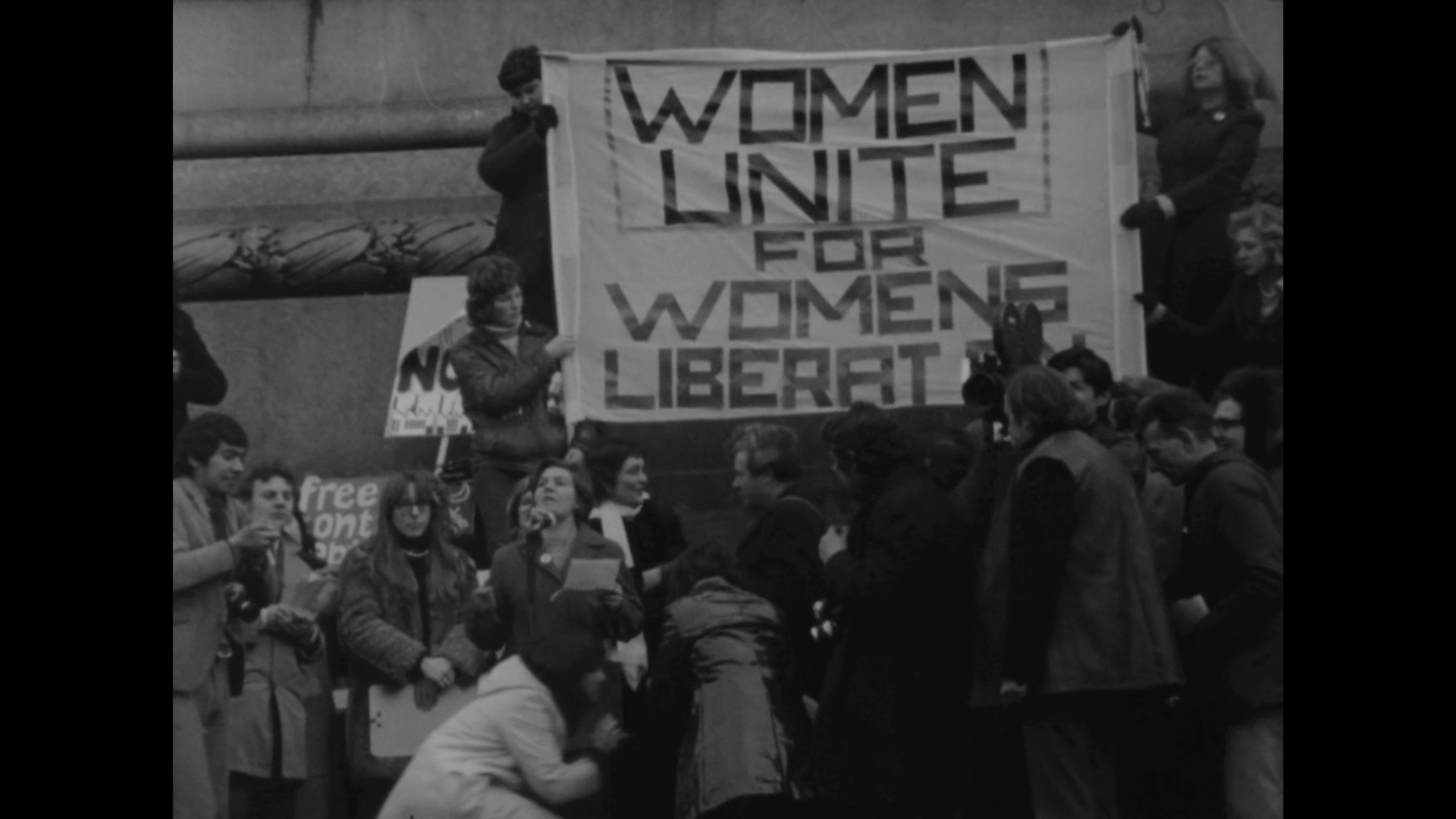
Between 1970 and 1972, a group of filmmakers (Richard Mordaunt, Mary, Kelly, Marc Karlin, Humphry Trevelyan and James Scott) working under the moniker Berwick Street Film Collective filmed women who spent nights cleaning the office buildings around London. This November, to mark the 50th anniversary of Nightcleaners, LUX are sharing the film online until the end of this week.
The film follows the gradual engagement of the women with their struggle, finding themselves caught between their bosses, who treat them unfairly, and the trade unionists, who don’t listen to them. As independent, female-led workers’ collectives like the Cleaners Action Group, they led their own parades at the protest marches in 1971, following the Heath government’s Industrial Relations Act, which (ironically) sought to suppress unionism and worker striking.
The documentary follows several women through talking-head interviews, filming their labour and sitting in on CAG meetings, creating a sense of the power of communication and solidarity that allowed these women to mobilise. This is mixed with slow-motion, extended periods of black leader, and extreme close-ups that attempt to capture visually the agony of being overworked, underpaid and frustrated.
While BSFC’s Nightcleaners, the first of a two-part profile of the workers, contains maverick techniques which have inspired dozens of documentarians, the original intention remains to contribute to fighting political struggle—a struggle that, 50 years on, is yet to be resolved. Many today experience the same struggles as the women in the film. Raising children, while also finding work to afford to raise those children, is still a gamble for many families; ahead of the Labour government’s autumn budget, many are preparing for austerity-lite, with the prospect of losing heating or food to fix economic disrepair, while those who caused it walk of unscathed, becoming all too real. Just as in the early ‘70s, mothers are a centrepiece in this struggle for justice—something that BSFC were all too aware of in the ‘70s.
The Collective emerged a few years after the London Filmmakers’ Co-operative, which had brought structural filmmaking to Better Books, just a stone’s throw from Soho on Charing Cross Road, in the late 1960s. Filmmakers like Peter Gidal, John Smith and Malcolm Le Grice were experimenting or, in some cases, completely disregarding illusions of signification to foreground a representation of the film apparatus itself. Films like The Girl Chewing Gum (Smith, 1976) blurred the distinction between filmmaker and filmed, while Room Film (Gidal, 1973) reduced signification to a collection of fleeting gestures.
Even within this principle, however, there was disagreement. Female members of the co-op, such as Lis Rhodes and Annabel Nicolson, took issue with Gidal and Le Grice’s approaches, which saw even the representation of the film strip as illusory. Rhodes exposed their free ability to make such claims as men by making films that foregrounded the labour of filmmaking as it related to “women’s work”, such as Light Reading (1978) and A Cold Draft (1988).
It is somewhere within this interior discourse that the BSFC sits. Indeed, it wasn’t until the cleaners themselves scolded the all-male Collective for their lack of female representation that Mary Kelly joined the team. At the time, Kelly was preparing what would become her magnum opus: Post-Partum Document, a collection of disused objects of childhood, from nappies to baby grows, that explore the matrices of signification on a deeply personal level. The BSFC’s political project, then, needed to avoid certain potholes in a historically male-dominated school of thought, if they were to accurately represent the cleaners.
The most striking choice in Nightcleaners, and undoubtedly the most written about, is the presence of black leader, which appears frequently throughout the film. Black leader is the blank film at the end of a strip that “leads” into the exposed celluloid. Its representation in a film, interestingly, is the example Peter Gidal cautiously provides of the ways representing the film strip itself can be illusory. For the BSFC, however, this “illusion” is wholly political, and to the advantage of their project.
LUX, in their written introduction to the online presentation, describe it (and the film more broadly) as representing the ‘struggles for visibility and justice.’ “Visibility” is a key term here, and speaks to Gidal’s point: it reminds us that the black leader isn’t a lack of representation, but a representation of lacking—or, more accurately, of elision. It is no coincidence that these women work at night, not only hiding the dirty work from society, but also hiding their improper treatment, whether it’s bad pay or bad conditions (or often, both).
Just 20 years before, prominent Marxist thinker Theodor Adorno responded to the intellectual Marxism dominating culture and political science with one exasperated question: ‘Where is the proletariat?’ To him, Marxism had become like a rabbit-frog illusion, the intellectualisation of Marxist theory reducing the proletariat to a mere component in a matrix; ‘extreme injustice becomes a deceptive facsimile of justice, disqualification of equality’ (Minima Moralia).
By the time we get to the London structuralists (or what they called Structural/Materialists), we can see that not much has changed. Their pre-occupation with semiotic systems within a filmic space pushes them into the realm of the theoretician, having the means as well as the capable hands to create a treatise on a condition they themselves do not suffer from. It is what many contemporary Marxist thinkers, like Katerina Kolosova, have called a “wisdom” or “superior knowledge” that does not lead us to the “direct interests” of the workers.
Of course, their films were not always meant as grave critiques; many, particularly John Smith’s, had comic tones. But for a real example of the “direct interest” of workers on film, Nightcleaners is far superior. What we feel, in these moments of stillness, where it’s only the women’s voices we can hear, is not only a representation of the “night”, where the work is unseen, but also the exhaustion of the work that Marx originally identified as the space where political engagement naturally occurs.
Perhaps the leading writer on the film is feminist film theorist Claire Johnston, who claims that ‘we are no longer consumers of the film, we become part of the learning process.’ What we see in this idea echoes the Dziga Vertov Group’s film British Sounds from a few years before in 1970, where black leader stands in for a blackboard on which teachings occur. In Nightcleaners, however, the materialist approach feels closer to the action, uniting the “knowledge” of the classroom with the “direct interest” of the workers.
Indeed, there are moments where the black leader interrupts speech, movement, and music. What is a literal “black” screen is instead filled with movement-images, bursting the edges of the frame and connecting the blackboard discourse with the images of labour in our minds. The women in the CAG also closed this gap through leafleting, which included information about strike action and literature about the struggle, handed out as the women went in and came out of the office buildings. Just as the images and the blackboard coalesce in our minds, so too do the labour and the political mobilisation in the minds of the cleaners.
The BSFC, then, does more than chronicle the rise of a workers’ movement; it becomes part of it. As a Waterloo train conductor surmises at the end of the film, musing about the various organised protests happening at the time, ‘they sing the same songs; they understand the same language.’ Having watched the film multiple times over the last few years, with the opportunity now to watch it in the comfort of my own home, I’d like to think that people today are still speaking the same language. With many experiencing the same struggles 50 years on, LUX have seemingly got the timing just right to bring Nightcleaners back onto our screens.
Berwick Street Collective: Nightcleaners (Part 1) is an online exhibition running until 17th November. To find out more, visit the LUX webpage.
Image courtesy of the artists and LUX, London.


