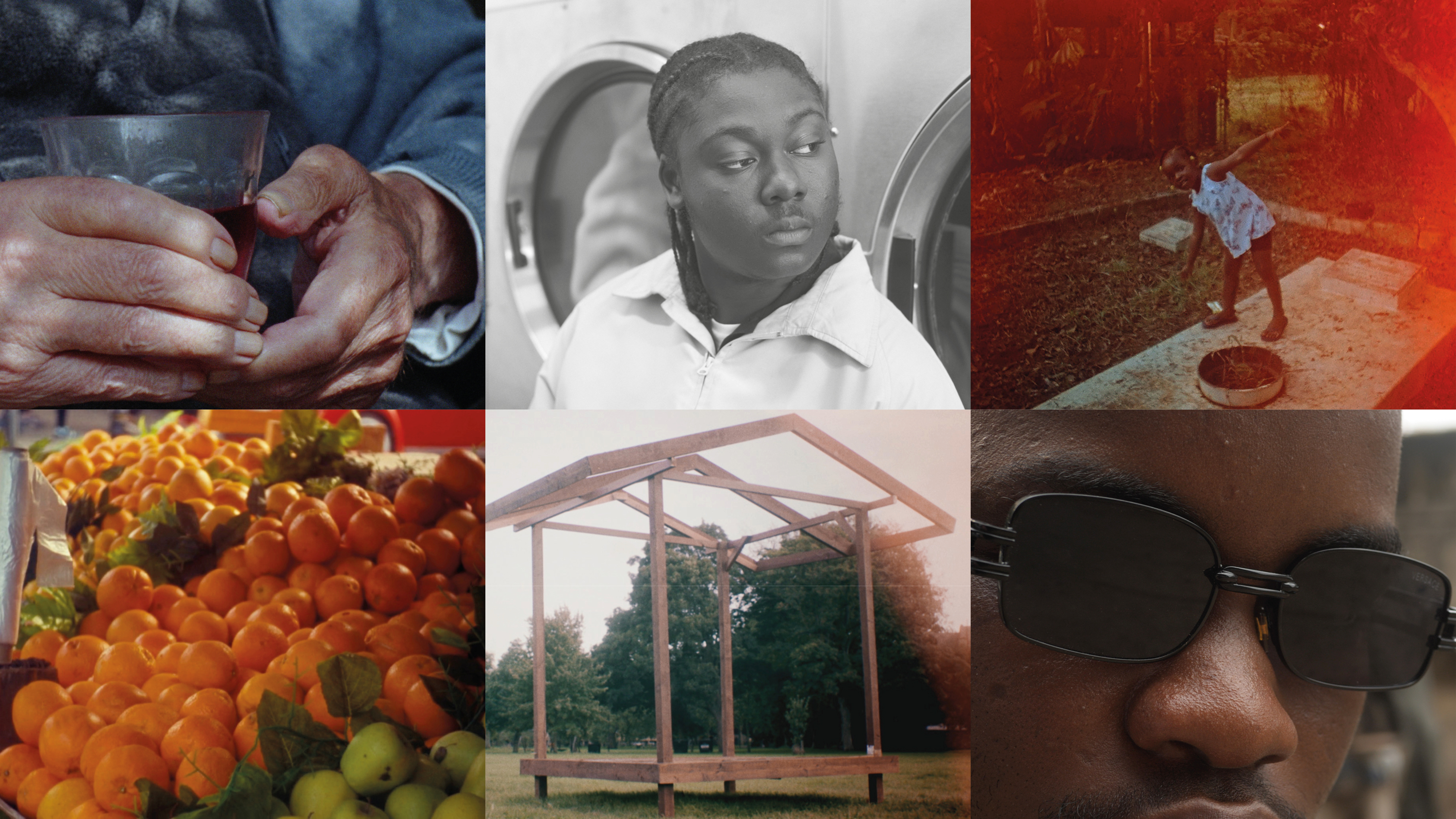
This month, the Film London Jarman Award 2025 will show off the best of artists’ moving image from recent years. The programme is touring the UK, with London’s Whitechapel Gallery hosting the award ceremony later in November.
This year’s shortlist includes films by Karimah Ashadu, Morgan Quaintance, Hope Strickland, Onyeka Igwe and others, all of whom regularly work with film to produce artworks that comment not only on pertinent social issues, but also on the state of filmmaking itself.
Karimah Ashadu’s film Machine Boys (2024) follows the underground motorcycle taxi network in Lagos. Since local government restricted their use in 2012 because of increases in dangerous driving, the taxi drivers now resemble a sort of biker gang. The meshing of human and machine we’d expect of this image is very much intact, but with an allegorical edge, commenting on our dependence on technology, travel or otherwise, that blurs this distinction.
Driven by content, Ashadu’s film could not be more different from Onyeka Igwe’s The Miracle on George Green (2022), which works in the register of memory and archive to tell the collective history of commons as communal spaces. Using the George Green treehouse in East London as an entry point, Igwe re/collects protests to protect commons around the UK, even branching out to New York, contributing yet another film to her corpus that finds a new way to communicate collective histories through archive and memory.
The shortlisted films for the Jarman Award 2025 all seek to push boundaries in the making of art. But these boundaries are not just around the way we think about social or political issues, like the politics of green spaces or of biker taxis. They also push the boundary of the cinema screen, making us question what it is we’re looking at when we watch a film. Why do we make certain decisions when making films? What sort of labour goes into making a film?
Morgan Quaintance’s Repetitions (2022) asks exactly this latter question; foregrounding the flickering image that is hidden from us in most narrative cinema, Quaintance makes a suggestively Marxist case for the repetition of labour. Image and sound loops speak to social histories, contrasting greatly with Igwe’s approach, but yet just as powerful in its message.
Where Quaintance’s film is moving towards a more metaphorical approach to allegory than Igwe, Turab Shah and Arwa Aburawa’s I Carry It With Me Everywhere (2022) pushes this further towards politics of identity and belonging as they are mediated through film. Based on multiple interviews with first-generation migrants living in the UK, the film’s message sits in the space between the filmed image of migrants and the image that politics creates of them. Motifs of self-identification mesh together to undermine antagonistic governance towards immigration in the UK, predicated more and more on a “cinematic” identification with the “other” than a compassionate, human understanding.
Uniting these ideas of repetition and identification is George Finlay Ramsay’s Flesh Wax & Glass trilogy (2025), the first two parts of which are nominated for the award. Following bloodletting rituals unique to Southern Italy, Ramsay creates an ethnography, but one that resembles the aesthetics of filmmakers like Pasolini. The film begets not only cinematic references that inform our understanding of violence, but also the violent ritual of mainstream film culture that allows for the inevitability of these connections, be it of Italian ritual, or of biker gangs, or of migrants in the UK.
Tying these together is Hope Strickland’s study A river holds the perfect memory (2024). Through this aqueous medium, Strickland tells a story of the connection between industries and people, connecting communities of people otherwise geographically (or indeed politically) disparate. Strickland’s film provides an optimistic allegory of the film form; of an art and a cinema that can bring people together for good, rather than for ill.
According to this year’s jury, ‘the shortlist for the Jarman Award 2025 is a powerful reflection of the richness and diversity of moving image practice in the UK today. The nominees each bring a distinct voice and vision, pushing the boundaries of form, storytelling, and experimentation.’ The films in this year’s shortlist exemplify this principle, providing a view not only of the future of film but also of the future of the politics that surround it. What is at stake for the awarding body is deciding which film best captures our moment; which film most destructively breaks down the boundary of the film screen; which film has the tightest grip on our arm, refusing to let us sink into escapism.
Indeed, for the first time in its history, Film London is screening the nominated works across the UK, providing the opportunity to view it in their own contexts, avoiding escapism much more easily. It will also make this year’s nominated works harder to miss, which, given the calibre of artistic filmmaking on display this year, you absolutely shouldn’t want to do anyway.
To found out more about the nominated films and where they can be viewed, visit the Film London webpage.
Image © Film London


